GardenImages

GardenImages
Our gardens in many lights

mardi 3 juillet 2012

May Wine and Bees

Cet article en français.
Este artículo en español.
The garden entryway, the meadowsweet is covered in white flowers, the wild roses will flower soon and you can just see the golden raspberry leaves in the down-right corner.
Sweet woodruff hides under the gold raspberries, 
at the garden's entrance. It's covered not only 
with its own flowers but also received a good
amount of petals from the meadowsweet making
the scene look like a wedding!
Hélène:
Welcome to the garden! The garden entryway was definitely at its best when I started writing this article, around the end of May - beginning of June. The meadowsweet (Spireae) was covered in sweet and tiny white flowers. This sight transformed itself lately with the flowering of the goatsbeard (Aruncus dioicus), that looks like ivory fireworks and the vibrant pink of the wild roses.

The month of May offers a strange ritual, well-known in Europe, whose origin is said to be from Germany (althought the French Wikipedia says it comes from Belgium - the english version states it comes from Germany). Maitrank, Maibowle, May wine or boisson de Mai, is traditionnally served on May Day holiday. It is made from steeping sweet woodruff (Galium Odoratum, also known as Asperula Odorata) in a white wine. Some sources recommand a sparkling wine instead, others mention adding orange slices or other fruits - I kept it simple, adding only the plant and some sugar to the wine and letting the mixture steep for 1 month.
 
The recipe I had found in this excellent book suggested either a Riesling or a Sylvaner wine, I contacted a good friend who happens to be a sommelier, Christophe, who also has a blog on wine, to ask for his opinion. He suggested this Sylvaner. I also took a Riesling by mistake - this, however, put me in a perfect position to test the difference between both wines.


The results are surprising. The taste of the wine itself is subdued and I could definitely taste the plant in all its strength. The recipe I tried required to had sugar at the beginning of the process and to serve it very chilled. Luckily I followed that last step, else I would have found the wine too sweet, since it's closer in taste to an ice wine. But the bonus of such a chilled wine is that it's definitely perfect for hot summer days!


-------------------------------

The bees :
The Juneberry somehow didn't fruit regardless of its multiple flowers. This gave me quite a scare, because it lead me to think that the winter - however mild it has been, in reality - managed to hurt also my powerful garden allies. I am referring to my solitary bees (megachilidae or leafcutters). 

Ready to steep for a month.


The finished product a month after!
The goatsbeard in the back
 looks like fireworks celebrating
the end of preparation!


However my ownership of them is untrue. After all, I haven't made a hive for them, I just prevented myself, at a naïve time in my life, from destroying them. After contacting the Montreal Insectarium who offers invaluable expertise on identifying insects, here's the information they gave to enlighten me along with some of my personnal observations on these amazing creatures.

Here's a bee coming out of its nest for the first
time of the year. New nests are highly 
visible; they often sport saw dust
at the entrance.

The wood planks that my raised garden beds are made of can accomodate - following my personnal observations - nests for about 20 bees per year, if not more. It is clear to me that these bees do a serious amount of work here in the garden. This year, I had the pleasure of seeing them wake up on May 29th. At this date, I not only saw some of them get out of their individual nests for the first time, I also managed to take picture after picture up close and personnal - and it didn't seem to bother them one bit!

I've taken a beautiful picture (show bellow) : A bee and a hoverfly gathering pollen from chives flowers. The answer of the Insectarium, while confirming the identity on these two individuals, also mentions that the hoverfly is an excellent pollinator as well and that its bee or wasp appearance is a defense mechanism (called Müllerian Mimicry).

In the chives flowers, there's not only 
a bee but also a hoverfly, a small
insect ressembling a bee or wasp, but its
movements are reminiscent of those of the hummingbird!
The hoverfly is also an incredible pollinator and its larvae
are fierce aphid predators!
When I moved to this house and garden in 2008 and saw the bees, I thought : "How am I going to work the garden, I have a small child that loves to play in there, we will disturb them for sure and they will sting us!" Well nothing. Nada, Nein. We never suffered a single sting and althought we do approach the garden with caution, these bees are not only peaceful and adaptables, but they visibly learned to tolerate us (and vice versa, let's admit it), they accepted us and then... Then. It's hard to explain what's going on exactly, especially since these bees provide new individuals each year (one bee can live only up to a bit more than a year), but it feels like we know and recognize each other and we are somewhat comfortable with each other.


For example, a couple of days ago, while harvesting strawberries, one came very close, enough for me to feel its wings beating on my arm and then it went away (gave me goosebumps too!). Maybe it just wanted to identify me. Last year, while I was hand pollinating my squashes with a paintbrush (related in this article), I cornered one in a flower. I definitely shook it up with my paintbrush and althought it came out of there dizzy , it didn't sting me (you may attribute this to the dizziness). I often work near the bees' nests. During that time, I clearly notice they avoid going in or out until I am gone. We have "an understanding". It isn't signed on paper, but it somehow works. So even if I unfortunately don't have Juneberries this year (and the cause looks like a late night frost), I'm at ease knowing my bees are back again this year and are doing well - extremely well, even.
Leafcutters make perfect circles
in my juneberry leaves 
and they use the pieces to create their nests
Regardless of the leaf's look, it is not 
lifetreatening for the tree.
If you too notice this kind of round piercing
on the leaves of your plants, it's a good
 sign that leafcutters are close by!
Indeed, leafcutters can only carry these bits
of leaves for short distances.


samedi 23 juin 2012

Goutweed or Tastyweed ?

Cet article en français.
Este artículo en español.

Louise : How to make friends with such a rascal ? 

First, one needs to know it better. Let me tell you about my own experience : in my garden, there's a nice looking ground cover perennial presenting a variegated foliage : Ground Elder, or Herb Gerard, Bishop's Weed, Snow-in-the-Mountain, Goutweed (because it was used as a remedy for Gout, a medical condition also called Podagra). In French, it's called podagraire, aegopode, petite angélique, herbe de Saint-Gérard or herbe-aux-goutteux. In latin, it is  Aegopodium podagraria, in Spanish, Aegopodium, Pie de Cabra, Podagraria, Yerba de San Gerardo.
 
In its wild form, it's plain green and grows in abundance from Europe to Western Asia. It can grow up to 60cm high (2 feet).
In Quebec, I encountered only the variegated form, the one you can find in some garden centers, and which is much shorter (20 to 35cm - 8 to inches high) and... less invasive.

So handsome for a rascal !
Our variegated Goutweed is appreciated because it makes a dense ground cover that - just like its all green cousin - eliminate competition, spreads vigorously throughout all the space it can get and forms a clump that illuminates its spot. It prefers dappled shade and gets along in any type of soil.
You will tell me : a handsome perennial for shade that can compete with weeds...
Where is the problem in this ?
Well, the problem is that it tolerates no other plant ! It will kill it. Even some bushes, like roses. I suspect that it's responsible for the death of my  Staghorn Sumac. I imagine that it must excrete  something at the root level... Add to this belligerant nature a desire to conquer the world ! I had a garden where it tried and tried to escape throught the lawn using its root system. European sources mention that Goutweed can selfseed. But apparently, it's not a problem in Great Britain. Here, I never noticed that behaviour either. 
Some say that you can cultivate Goutweed in pots and it's always possible to cut and remove the bottom of a plastic pot and push it down in the soil in order to make a barrier, so your plant won't escape.
In my actual garden, it was there well before us. Luckily, it has been located at the edge of our lot, under mature trees, bordering a gravel entrance way. I put a thick layer of tree leaves to mulch the edge of its territory and it never escaped.
On my part, knowing that I most probably could not get rid of it, I did not try and left it in place.

Friendly plant ?
It's only recently that I discovered Goutweed's usefulness in the kitchen and as a medicinal plant. Personally, it could as well be named Tasty Weed,so much we find it delicious.
I tried it in cooking only this spring and I was amazed : so good ! I did not take the risk to eat a lot of it at once yet, I used it, for instance, as a sidedish with meat. It's because I'm always careful when introducing something new in our diet. Allergic reactions or simple intolerance are possible, after all. 
Moreover, its taste is strong and I wanted this to work. After all, it's a marvelous thing to discover a new perennial vegetable in a garden, but we have to learn to appreciate it if we want to consume it year after year.
So, I tried it first in a potato and egg dish, then in a soup, and finally as a potherb in a veal meal. For those three dishes, we discovered with pleasure that Goutweed gives a different, rich and savoury taste to dishes.

 This plant has been used since ages in different ways
It seems that Romans brought it with them as far as Great-Britain and it has been widely used in all of Europe during Middle Ages. Today, it is still used in Scandinavia, Russia and Lithuania, either as a vegetable or as a potherb. 

In the kitchen
The "rabbit" that nibbled on all those 
goutweed leaves is me, with the help of a pair of scissors.
In fact, rabbits don't eat this plant.

We can eat the young shoots in springtime, in salads, or cooked, in many different ways, as a sidedish or as an herb in soups, omelets, and meat or potato dishes. 
Many Europeans consider it to be one of the best wild greens to eat. Others don't like it at all. 
It's supposed to be part of the carrot's family. Both its leaves and stems are edible. Their taste is quite strong, reminiscing of carrot leaves and parsley. 
Be cautious, though, since most internet informations on this plant mention that you must harvest it before its bloom time, because after that, its taste changes and the plant becomes laxative. A source gives this trick : in order to prolong the harvest, you just have to cut down the leaves regurlarly in order to prevent the plant from blooming. This way, it's supposed to be edible all summer long. I'll have to try it. 

What I did try was to freeze the leaves and I happily discovered that freezing does not alter the taste.
I keep certain of my herbs in glass jars, in the freezer.
Here, Goutweed, Lovage and Horse Radish, three plants with a strong taste,
each in its jar. 
Use in Herbalism
Medically however, it's to be harvested after blooming, and used fresh or dry, at least according to the site Plants for a Future. It's rarely used today, but it does indeed have a long history for its medicinal purpose. It's been used as a poultice for treatment such as burns, wounds, stings, achy articulations and in teas for arthitis and rheumatism. But its reputation comes mostly as a medication for people suffering from gout, hence the name Goutweed. This Wikipedia link will tell you more about this medical condition that can become chronical. It's linked to the metabolism of uric acid and it mostly attacks articulations, kidneys and skin.

What's the lesson in all this ?
First, the knowledge that useless plants don't exist at least from the nature's point of view. Each plant plays a role that Mother Nature provides always. In other words, if a plant appears and prospers somewhere, it means nature found a role for it to play there. This is also true for plants that suddenly take over an ecosystem because it means they generally benefit from an abundance of something that's not readily getting recycled by something else. Most often they are there to heal the damaged habitat and these plants tend to get replaced later on by other plants that get replaced by other plants. It's just a long list of specialist plants that work one after each other to heal the environment. That we see them as weeds is a very human perspective.
On the other side, it means a lot of work for the gardener who doesn't wish a certain plant at a certain place and this can create real problems, I know this from personal experience, probably like most gardeners around the world. But now, before dreaming up a magic wand that will rid my garden of undesirable plants, I will start by researching on it in hopes to discover its hidden virtues.

A couple of recipes for those who are tempted to taste it:

http://cuisinesauvage.blogspot.ca/ : This blog is extraordinnary, albeit in French. Pick "egopode" in the menu and you will find 3 different recipes. I heartily recommend "la galette d'égopode".

http://www.medecinesnaturelles.com/index.php?to=3&so=3&page=7 : Another one in French proposes a soup made from spring greens that are easily available in many gardens.


And to top things off, my own goutweed veal cubes recipe:

Goutweed veal cubes : 
Ingredients :
3 medium sized onions, diced
2 ounces (60g) goutweed leaves and stems, fresh or frozen, finely chopped
225 gr veal cubes
150 to 200 ml vegetable broth (I used the broth that resulted from the blanching of my asparagus harvest, I let it reduce to concentrate it more).
Olive oil
Salt and pepper

1.   Cook the onions and the meat in the oil at high temperature.
2.  Add the broth very slowly to prevent sticking.
3.  Cook for 5 minutes at medium temperature.
4.  Add the goutweed, stir and let cook another 5 minutes.
5.  Add salt and pepper.

Delicious ! Serve with couscous or rice, and steamed asparagus as a sidedish.

samedi 26 mai 2012

Under the rain portrait

Cet article en français.
Este artículo en español.


Helene:
Do you take a walk around your garden when it rains? I do because it's a fabulous world out there and perfect weather for certain tasks like transplanting a plant, albeit a very messy endeavor. Here's a portrait of my rainy garden in spring.


Juneberry full of flowers


Daylillies


Hostas slowly unrolling its tropical-looking leaves


Delicate Peach flowers


Spring is the ideal moment for observation, where we can witness nature waking up gradually, seeds sprout slowly and plants generally turning to beautiful colors.

This moment of wonder helps us to see what has changed in our environment after winter. For instance, I can already state that, because of such a mild winter, there's a lot more ants and butterflies than usual in my yard and since the snow cover wasn't always adequate, my 2 thymes have unfortunately died.

These times of reflexion allow us to judge what the garden will need this season and we can do this task in the delight of spring visions, even though they are transitory.

mardi 22 mai 2012

Touching at mid-April, daylily leaves are a treat on the menu!

Cet article en français.
Este artículo en español.

Louise :

Daylily Brand New Lover
Yes! You're not having hallucinations and I'm not crazy: We're talking about the daylily's young leaves (Hemerocallis fulva, Hemerocallis spicata), those that sprout out in a close spear and then deploy in a fan. If it's been known for a while that the flowers and even the flowering buds are edible, very few gardeners seem to be aware of the edible value of their spring shoots.
Deer love their taste and now that I eat them myself, I whole-heartedly agree !
It's pretty easy to find recipes incorporating daylily
flowers on the net. On the counterpart, you need to
search thoroughly for recipes calling for the plant's
flowering buds or spring shoots.
First off, what plant are we actually talking about ?
Many mistake the daylily (Hemerocallis) with the lily (Lilium) but also with the iris (Iris). Those 2 last plants are toxic to a point. All 3 are perrenials, are a rather common sight in North America's gardens, and do have an exotic look.
Stay prudent and make sure you are 100% sure on the identification of each plant before eating it (consult with someone you trust - a professional for instance - or a good book on plant identification).
Even more, make sure the site you are about to harvest from isn't polluted or otherwise contaminated.
Even if you know the plant, for the first time you eat it, it is still recommended that you take only a small quantity to make sure your body reacts well (an allergy or intolerance is still possible). By the way, in general, a raw plant is more likely to cause someone an adverse reaction than a cooked one. 
Some sources mention that the daylily's leaves can provoke a "digestive system's distress" (read here diarrhea) in one in fifty people. Personnally, I also think that our body needs adaptation to pretty much anything new, especially if the plant in question is vigorous enough to grow out-of-the-garden, surviving in the less likely places and even reproducing there (like roadside ditches). These plants tend to be more nutritious than a tamed garden vegetable that doesn't have to fend for itself in the wild and so these strong plants are more likely to give our civilized stomaches some trouble.
There's a description of the daylily, lily and iris at the end of this article, to help you identify each if need be.

These young greens are tender,
without a doubt, but I'd rather wait

for the whole plant to get out of the
ground before harvesting. 
An easy harvest :
I'm not touching my spring-flowering varieties of daylilies (those that flower in May or June), because it could postpone their flowering, but also because those spring species are not the exact same as H. Fulva. I haven't found so far documentation saying you could eat those. So instead, I focus on the hybrids that bloom in full summer.
 I harvest all the shoots of a given plant, in one shot with a good pair of scissors, but only once a year and then, I leave the plant alone to regrow its leaves, and don't touch them for the rest of the gardening season. 
Later in summer, I will return to harvest the buds and/or the flowers, as many as I want to eat. Collecting flowers is harmless for the plant and since the daylily flower lasts only a day (much more rarely two, depending on the cultivar), it's not such a big deal to take flowers that won't be there the next day, anyway.
Next year, I'm seriously considering
covering my plants with a floating cover until
harvest to reduce the time spent
cleaning the leaves.
To get back on the leaves' case, I do need to wash them thoroughly. You see, my yard lies under a thick canopy of trees and therefore, vegetal debris tend to get stuck between the leaves. At least, the deep layer of mulch made by the falling leaves of the trees in automn prevents dirt from getting in as well. Half of the cleaning problem solved. Anyway, once dirty, this green takes long to clean up, because of the need to check the inside of each leave. 
Next they are ready to eat, raw or cooked.
I prefer them cooked. It gives them a delicate taste of green beans and their texture is similar to the tender green parts of leeks. Steam cooking will conserve most of their nutritious value, of course. 
This year, I managed to harvest 1 to 5 pounds of fresh leaves everyday, every time a plant was about completely out of the ground and gained a respectable height  (around 8 inches - 20cm). Generally, we eat part of the day's crop right away with the next meal, raw or cooked, and I blanch the rest (a minute on the stove in boiling water, or  40-60 seconds in the microwave oven at max power, in a small StarFrit silicone steamer, withour adding any water). Next I quickly plunge them in cold water to stop the cooking process and I wring them in a clean cloth to remove excess water). Finally I place them in a recycled plastic bag (I reuse my old milk bags this way), I close the bag with a bit of scotch tape, and insert it in a second bag - to prevent freezer burn. Weigh, identify, freeze et voilà! Next time I need some, it's right there for the taking.
Roadside Tiger daylilies,
3 weeks after I harvested them.
It's getting back quite well.
This year, I expect to harvest about 30 pounds of leaves (at the beginning of May I already had 16 pounds in the freezer, without accounting what we ate fresh).
Last year, the harvest was small in part  because I feared I might damage my plants. But they recovered so fast and took such a beautiful appearance, I realize this fear was unfounded - their flowering wasn't even delayed.
Therefore, this year, I harvested  the totality of the shoots once on each plant, so we'll see if it has any indesirable effect on the plants. But I'm not really worried. After all, a hard frost could easily kill the young leaves and it wouldn't affect a healthy plant.
To the table!
A simple meal:
parmesan squares,
Californian strawberries

and daylily's young leaves
cooked in the microwave oven, in a steamer, for 60 seconds.
An omelet made of ham, cheese and daylily young leaves,
accompagnied with cherry tomatoes and yellow beans,
both coming straight from my windowfarm.
Not bad for a mid-April meal!
My turbot and scallops chowder with daylily's spring leaves,
simply accompagnied with a rye bread toast, buttered
and sprinkled with dried thyme on top.
My husband liked this meal so much he swallowed 5 bowls!
We were saying : What is this plant again?
Daylillies come in many colors, but blue doesn't exist in its palette (it's actually the case of many plants). The shape of the flower itself is also variable.
Typically the daylily flower is widely opened and presents 3 petals and 3 sepals. There's also some flowers that boast double (or more) the normal sets (apparently these varieties are less odorous and so in result have more trouble attracting pollinators). Each flower lasts a day - this is from where the name comes from - but some cultivars or species can push this to 2 days before the bloom wilts and is eventually replaced by another elsewhere on the stem. The flowering period depends on the cultivar but some last only 2 to 3 weeks while others, like the popular golden Stella de Oro, are in bloom almost all summer.
Daylily Jubilee Pink - one of the 60 000 cultivars and more registered in the Daylilly American Society. They produce pink flowers and as you can see, they tend to look up (towards the light). Besides cultivars, about twenty different wild daylily species exist.

Daylily roots form a mass of tubers
going from the size of a pea to that of a finger.
Maybe the most well-known species in North America, here is the
Orange Roadside Daylily, aka Tawny daylily or Tiger Daylily (Hemerocallis Fulva).
This beautiful, invasive, bright orange beauty grows in ditches
along our country roads.

Notice how the stalks are practically leafless.
 The french site Les beaux jardins offers a nice rendering of what the plant and its root system looks like.  The plant's leaves do look like giant blades of grass, grouped in a rather undisciplined fan, definitely less than the very straight fan of the iris. To get ready for the flowering period, the plant produces several stalks of varying height (depending on the cultivar) and these stalks are almost or entirely leafless and sprout from the center of each fan of leaves. At the end of each stalk, small branches will form and on each small ramification, a bud will appear. When ripe and ready to open, the flower looks somewhat like that of the lily (most likely the source of the confusion) but this flower will only last the day (or two). On the other hand, Lily and Iris flowers will last many days before wilting.
The  German Iris (aka Garden or Bearded Iris), from which the rhizomes 
are visible on the surface of the earth.
Iris left, daylily right.


Iris down, daylily top.
Iris's flowers can be
simple or double and their
hue varies greatly,
from white to true blue,
yellow, burgundy and black-red,
golden, peach and pinkish.
The iris (Iris) are, depending on the species, a plant with a rhizome (a kind of plump root lying on the surface of the earth, horizontally). Garden Irises have this feature while Holland Irises have bulbs (the onion looking tuber). The plants form leaves that shoot straight up, have a very thin lance (or sword) shape and looks exotic. When the flowers appear however, there's no more confusion possible. These flowers form along an almost leafless stalk in a zigzag pattern, on one side of the stalk then the next. The stalk may have many branches. 
The leaves are rougher, straighter and thicker than the daylily's. They often sport a bluish hue, sometimes with streaks of white. 
 The iris is much likely the model for our national lily, the symbol we can find on the Quebec flag. Check Larry Hodgson's article on the subject (it's in French, sorry!). Iris versicolor, a species that grows in Québec, is our national emblem.
The Lily (Lilium) is a plant growing from a bulb, like tulips, and so the underground part looks like an onion covered in scales, from where the stalk will sprout. Check the drawing in this article (text in French, but drawing very informative). Leaves grow all around and up the flower stalk, they look like short arrowheads, generally they are all the same length and this gives the plant a columnal look. On top of this stalk, the buds will form, elongating until they open up in a trumpet-like flower that will last many days and of which the hue can vary greatly from one cultivar to the next. Again however, true blue doesn't exist for the lillies. Unfortunately, I don't have any pictures of them, I removed most of them from my garden because of a cute, hard-to-get-ride-of red insect, the scarlett lily beetle named so for its unrelentless culinary love of the plant's leaves.

Without a doubt my favorite variety, 
Frances Halls, here accompanied 
by golden raspberries 
and yellow cherry tomatoes,
 this is last July's harvest.
Hélène :
When you're done with the daylily spring shoots harvest and start on the flowers, remember one thing. Dark-hued flowers are supposedly less tasty (some say the taste is reminescent of iron) than the fairer ones that are sweeter in taste. It is also my experience that the dark reds aren't as good as the yellow or pink ones!

Louise :
It's possible to eat wilted flowers (collect them at the end of the day, when they are closing up, or the next morning). They can be part of a stew, a stir-fry a spaguetti sauce, an omelet or a soup. Bon appétit!

samedi 5 mai 2012

Beauty and Weirdness in Springtime

Cet article en français.
Este artículo en español.

Louise :
My turn to show you a couple snapshots of my garden!

Snowdrop (Galanthus, pictured above), Glory-of-the-snow (Chionodoxa), crocuses, Dog's-tooth violet (Erythronium), pushkinias (P. Scilloides), Siberian squill (Scilla Siberica) are the first to bloom gloriously. Then, when the flowering ends, they just have to accumulate their reserves for next year and go back in dormancy.
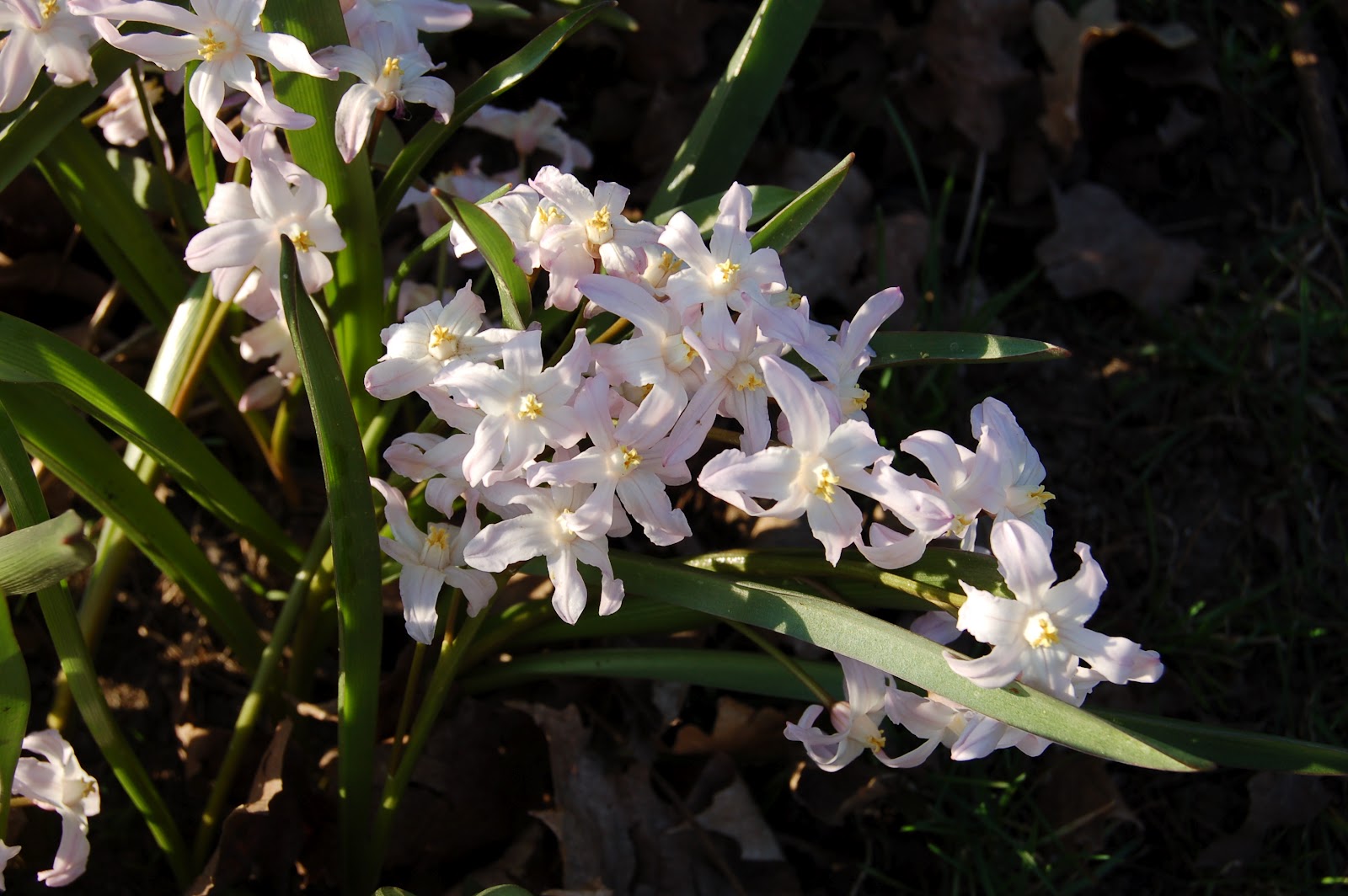
Pink Glory-of-the-snow
Crocuses Ruby Giant
Pushkinias.
Bulbs' blooms - and spring flowers in general - don't last long.
These plants have to hurry up to complete their reproduction cycle before the first tree leaves appear, which then will shade them from the sun.
Lovage -a tasty perrenial that is reminiscent of celery leaves.


Lily of the valley - my mother's favorite flower - unfolds slowly in the sunshine.
A floral stalk as already appeared, preparing its bloom in a couple of weeks.
Grape hyacinth's solid blue contrasts lovingly
with the coral trumpets of the narcissus in the backdrop.


A double narcissus couldn't stay up with the snowfall 3 days ago.
Tulipa Tarda
This is a botanic type of tulip
(meaning it keeps its wild state from its country of origin).
It is considered a perrenial since it grows and expands year after year.
It also propagates itself by seed.


Tulipa Greigii Red Riding Hood.
Another botanical tulip that will stay strong year after year if it likes its assigned place.
That's why it's considered a perennial.


Darwin tulips (this one in pink) are considered
one of the most perennials in the hybridized tulips category.
I had a bunch that lasted 10 years and it even expanded a bit

before a deer came along and ate it.
Guess what this is?
First clue : it's flora.

Second clue :
It creates a cloud of dust when a good pressure is applied.


Third clue :
it once was edible.
Here's what it looked like last October.
Thats when I named it "the piglet".
Go take a look in this past article.