GardenImages

GardenImages
Our gardens in many lights

lundi 31 octobre 2016

Agrotourism, a real pleasant experience

Cet article en français.

 A superb pear, as soon harvested, is passing from a grandson's hand to his grandmother's.

Hélène:
Fruit picking - like apples, strawberries, raspberries... - just as we know it today, is not a new trend. But it developped far behond harvesting produce. Agrotourism offers many recreational activities in rural areas, magnifying our experience, and our family's. 

Many ways to cook pears!
There are many places everywhere in Quebec that offer such an experience.
In October, we made a trip to a marvelous village south-west of mount Yamaska, St-Paul d'Abbotsford (look at the tourism section on this municipality's site). In the orchard Verger du Relais, we harvested pears and apples to make jams and preserves. Louise wanted to bring back a bushel of 'Beauté Flamande' pears mainly to eat them fresh. To her and her family's delight, we can keep them whole for many weeks in the refrigerator's produce drawer. In fact, one month after this harvest, she still has a good stock of them. She deposits a handful in a basket placed on the counter and let them rippen. 

Before departing from the orchard, we spread a blanket over a grass patch bordering the fruit trees and savoured our picnic.
Régis.
Then, we headed for the King of the Strawberry, le Roi de la Fraise, a farm offering diverse produce according to the season, from strawberries, to apples, to squashes, even preserves and homemade pies. We were interested to visit their miniature farm (for free!), home of some chickens, rabbits, ducks, poneys, goats, llamas and a pig named Régis. Furthermore, there was a picnic area and a big playground for the kids. It was Louise's second visit this year, as she brought her class the week before. Many farms involved in agrotourism open their doors to school groups. 

A Tic Tac Toe game at le Roi de la Fraise
In this day-trip, we had only time to skim over the proverbial cornucopia. Agrotourism offers us so many different activities: farm stays, tractor rides, sports, patrimonial tours, country-style tables where we can taste farm produce, etc. Many farms in our countryside (elsewhere in the world, too) open their door to welcome us, a nation of food lovers avid to reconnect with the source of our sustenance!


A pumpkin field - we found the perfect one for Halloween!


vendredi 30 septembre 2016

Rhubarb: juice, syrup and compote all at once

Cet article en français.

Our rhubarb plants, behind the squashes.
Louise : 

I mentionned previously that rhubarb was used in different ways besides compote or dessert in this household. My harvest at the end of August of 2016 gave me 6 kg (13 lbs) of rhubarb cut out in cubes. It took me 3 hours to wash, peel and dice the stuff (I did it in front of the tv, it helps). The following evening, out of this quantity, I used a little over 2 kg to cook the triple recipe I'm describing here. I was mixing with one hand and taking pictures with the other! I didn't precisely note how much time each step took, but after 90 minutes, I was scrubbing the last corner of my kitchen counter  before closing the room for the night.

   
Three different products from the same
harvest. From left to right, compote, sweetened

juice and non sweetened juice in the bottle.
 Here, in pictures, is my step by step  process to make, in order:
 - Non sweetened juice that can replace  lemon juice in recipes.
 - Sweetened juice or syrup (depending  on the consistency), that is the base for  a sparkly drink.
 - Compote that's less acidic than the  traditionnal recipes.


My ingredients

 - 5 pounds (2,27Kg) of rhubarb, peeled  and diced, that gave me a volume of 5,5  liters. (Hélène on her side doesn't bother  peeling the rhubarb. Her juice comes out  pinker than mine.)
 - 1 cup of water.
 - Sugar according to your taste (I  added  about 1,5 cups). You can replace  sugar with another type of sugaring  ingredient. Maple syrup, for instance.

 Utensils and containers

- Cooking pot of 6 liters with a lid
- Wooden spoon
- Small sieve (made out of metal is fine)
- Small bowl or measuring cup to collect the juice
- Big sieve
- 2 big bowls
- Measuring cup for the sugar
- Jam funnel (big hole for the jam to pass through)
- Glass mason jars
- Funnel for the liquid
- Empty bottles, small containers for the juice and syrup
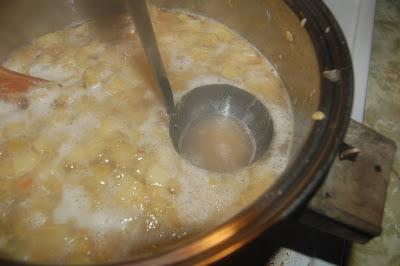

Photo 1 - As soon as the rhubarb cubes start to
 collapse under the  pressure of your spoon,
they have cooked enough. You can see me start

 extracting the non sweetend juice with a
ladle on this picture.
First step : Cooking the rhubarb

1. Place the rhubarb dices in your cooking pot and add the water.

2. Over a medium flame, bring to a boil while stiring regularly so the rhubarb doesn't stick to the bottom of the pot and burn. Adjust the heat if needed.

3. Bring the heat down and let simmer until the dices are soft and start to fall apart under the pressure of your spoon (photo 1). In traditionnal recipes, cooking takes a lot longer to give time for most of the liquid to evaporate. By collecting this liquid, we collect a useful byproduct instead of wasting it. Even better, we save time by skipping the evaporating step altogether.

Photo 2 - The non sweetened juice passes through
a sieve to separate it from the inevitable rhubarb

pulp. Note : the 3 jars behind the measuring
cup contain canned tomatoes that I cooked
during that same evening.
Second step : Separation of the non sweetened juice
Since I only needed a modest quantity of non sweetened juice for my needs, I used a ladle, a small sieve and a measuring cup.

4. Sink the ladle slowly in the compote so only juice will trickle into it (photo 1).
Photo 3 - Don't throw away the pulp left in the
sieve. Just put it back in the cooking pot.

5. Pass this juice through the small sieve placed over the measuring cup or over a small container that can resist high heat (photo 2).

6. The sieve will catch any rhubarb pulp that ended up in your ladle (photo 3). It's pretty much inevitable, so just put it back in the cooking pot after the juice has been extracted.

 7. Let the juice cool. Once it is done, you can freeze it in smaller portions and use it instead of using lemon juice. I give instructions on the freezing process under Photo 10.

Third step : Add the sugar
Photo 4 - The amount of added sugar
depends largely on personnal taste.

8. Incorporate the sugar and let the compote cook for 10 more minutes so the sugar as time to dissolve (photo 4). 


Photo 5  - Don't squeeze the pulp. This way, none
 of it will pass through into the juice. Besides,
it's a good thing to keep some of the juice into
the mixture.
Fourth step : Sweetened juice separation

9. Carefully transfer the compote into the big sieve that you put over a bowl. The juice will slowly pass into the bowl. Of course, the tighter the weaving of your sieve is, the less pulp will pass through, too (photo 5). You can also use cheesecloth to have a better filtration process.

Place the pulp left in the sieve in another big bowl and pursue the operation until all the compote has been separated: juice on one side, pulp on the other (photo 6). I think it's a good idea to leave a little bit of juice in the compote, so it doesn't end up tasteless and dry, but also because the rhubarb juice is sufficiently acidic to prevent bacteria formation.


Juice or syrup?
Photo 6 - The rhubarb juice, sweetened or not, has a nice
pink hue, just like the syrup. The pulp, without the
 juice, looses a lot of it trademark acidic taste.

10.To obtain a syrup, put the juice back on the stove and let it evaporate until the consistency of syrup is achieved.


Last step : Preparing the compote


Photo 7 - Watch out! The compote minus its juices
sticks to the bottom of the pot more readily.
10. Put back the pulp in the cooking pot and bring back to a boil while stirring frequently to prevent burning. Taste it and add sugar if needed (photo 7). 

11. The compote is ready. You can let it cool for either further freezing it or simply putting it in the fridge.

You can also transfer it still blistering hot in sterilized Mason jars, close them tight, put them in a large pot  and cook them in boiling water for twenty minutes. It's the basic canning method that you can find all over the net. Here's one. Here's Ricardo's method, if you don't mind reading it in French.

Photo 8 - A large-mouth funnel makes it easy to fill
Mason jars without making a mess.


Photo 9 -I like to recycle old pill bottles 
(thoroughly washed) to preserve the non
sweetened juice in small portions. I fill them at 

80%, so once frozen, they won't overflow.

Photo 10. I gather my pill bottles inside a bigger 
plastic container and I freeze the batch 
without the lids on, so the bottles won't distort
through the process. The juice doesn't expand
that much so it generally doesn't overflow.
Once it's frozen, I just place the lids on.
There's a very useful preserve!


Photo 11 - One last tip : rhubarb is a very acidic plant,
it can alter the material of your sieves, if they are not
made of stainless steel. So it's a good idea to rinse your 
sieves under water as quickly as possible after you have
used them.

Conclusion

I recently used my non sweetened juice on fish - replacing the classic lemon juice. I used it on apples to prevent them turning brown and I used it in a couple of recipes that called for standard lemon juice. I added it to a cocktail and I used it as a base for lemonade.
As for the syrup and the sweetened juice, there are a couple of things that I can envision: adding a dash over ice cream or drizzle some on fresh fruits, for instance. But up to now, my preference goes to a simple drink : half rhubarb juice with half carbonated natural source water, add a couple of ice cubes and drink in good company. Cheers!

mercredi 17 août 2016

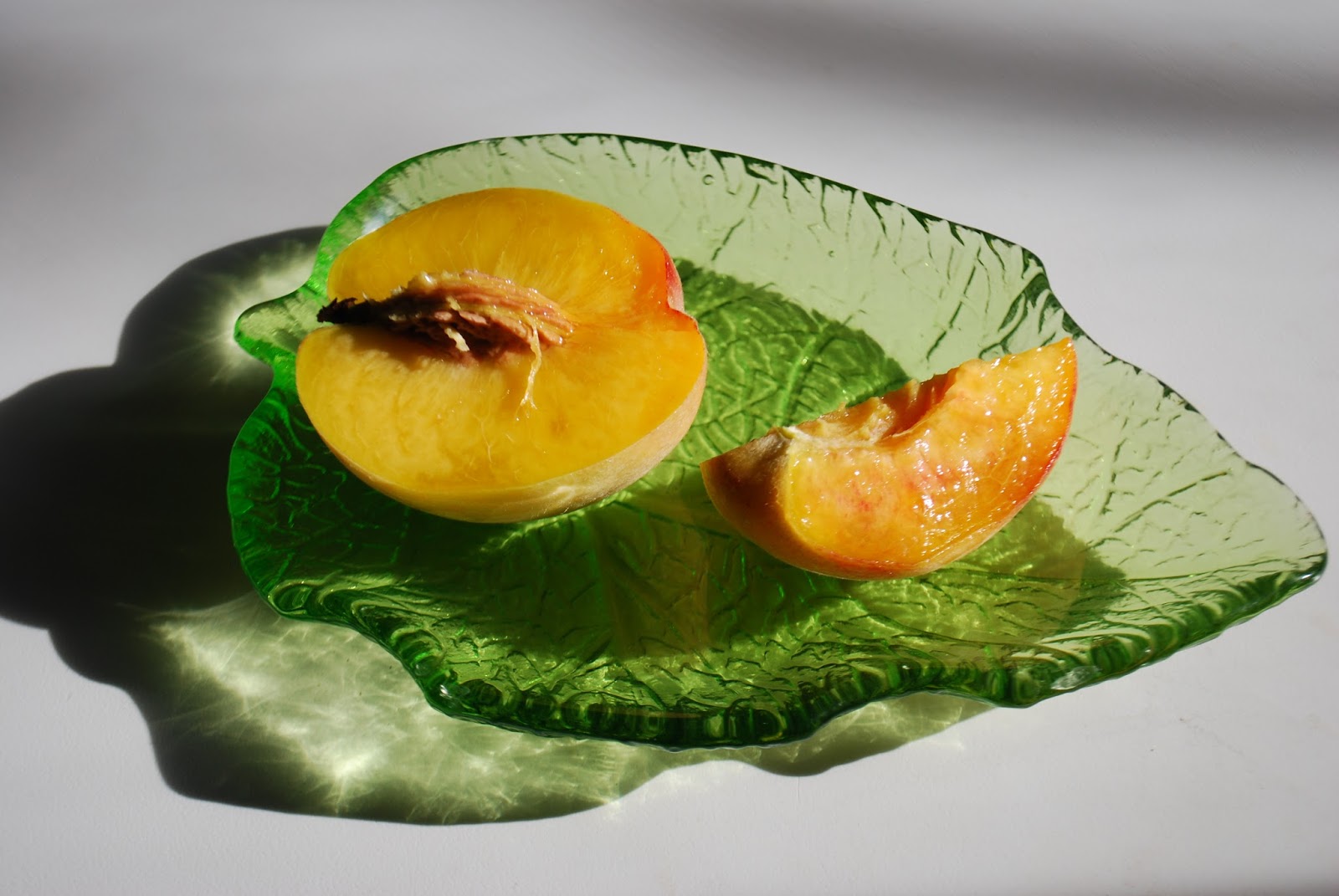
The velvet of the peach, take two

Cet article en français. 


Follow-up from the article dating back to August, 2012.

Hélène:

Les fruits encore très verts.
Three years. It has taken three years of rest before my peach tree produced fruits anew. The wait was long, but boy ! Was it worth it! I had to make the concession of giving the tree commercial fertilizer to help fructification (I hate doing that, my permaculture leanings telling me that if I planted good plants in the approriate places, I wouldn't have to add that kind of amendement to my perfect soil). I was recommended tomato fertilizer, so I added some in the spring of 2015, the autumn of that same year and the spring of 2016. Now that we are in summer 2016, I can happily declare that I harvested 31 of the 44 fruit that my tree produced ! I lost 8 to 10 to squirrels - as they are my terrible bane, they came, tasted many fruits that weren't ripe, threw them to the ground and scampered. Another 2 to 3 fruits I left high up in the branches, unreachable by me and my ladder. I'm not going to break my neck for a peach - however, I must say they are almost worthy of it.

A couple of days before the harvest, witness the abondance.
 I don't protect my tree. I don't spray my tree. If I had many trees, maybe I would use these methods to protect the harvest from parasites that generally profit from a monoculture. But my garden as so many different plants species - some that are there to bring in predators of parasites - that with only one peach tree, these commercial techniques are unnecessary. Furthermore, the idea of spraying poison to get food is wrong in my mind, especially for a tiny garden.

But it means I do have to accept the occasionnal fruit with sting marks, the occasionnal distorted fruit. I need to be able to deal with a fruit munched by squirrels that now has 20 ants crawling over the munched area (and I now that that, for some, is an unbearable idea, but I honestly don't mind those fruits after a good wash and peel of the affected parts. For my friends to whom I gave fruits, don't worry - those ants and squirrel munched fruits, I kept for myself, never for you!). Beyond all that, most of my harvest was marvelous with more than half of it being perfect fruits and with only one fruit badly distorted. 

Louise's sidenote : I think your tree did marveloustly well. Indeed, commercial farmers too get their lot of bad fruits. However, they can't sell those to grocery stores since most customers generally won't buy such fruits and vegetables.


On the left is my imperfect fruit and on the right is one that a squirrel munched on.
Sting marksfrom insects are visible on some of my fruits.
 I ended up with sweet, juicy fruits (the kind that you have to eat over the sink because of all the juice), a flesh so perfect it detached itself from the pit with a simple twist and most of all fruits that have nothing to do with the sad, lumpy fruit we get at the grocery store. Why are they like that at the store anyway? There are a couple of very simple reasons.


First, they are harvested green, or at least underriped. If they were harvested at their peak, they would become pureed after their long trip to reach the grocery stores (sometimes they travel hundreds of kilometers to get there). Especially delicate fruits like peach that would turn to compote at the slightest rumble.

Second, The varieties of peach trees planted are chosen based on criterias that aren't what consumers would choos,e but criterias that make perfect sense for a producer. Instead of choosing a plant that produces the best taste or the juiciest fruits, a producer will be better off with a tree that produces fruits that can travel well or that can stay better looking longer. So the taste criteria - althought important - isn't at the top of the list when a producer select his trees. By the way, that whole reasoning is true for anything and everything: from those Florida strawberries to those Mexico blueberries. When you go to your local farmer's market however, we can expect taste - not transportability - will be more important. They don't have hundreds of kilometers to do to sell their produce, so they can buy trees that have the reputation of bearing better tasting fruits.

Louise:

Third, the peach, just like the nectarine, the banana or the sweet potato, doesn't do well if refrigerated, according to Ken Allen, who explains it in his book Sweet potatoes for the home garden (page 32). To brush a quick portrait, peaches have a natural tendency to rippen quickly after the harvest, so they must be refrigerated to be able to reach the consumer. But the process of refrigeration affects the taste and the texture of the fruit and as soon as we bring the fruit back to room temperature, for example on the kitchen counter, the fruit tends to rot, regardeless of their previous apparent perfection.

Back to our peaches, I will thus not surprise you by claiming loud and clear that my peaches - regardless of the 3 year wait - have been such a wonderful success. They have no equal and we have enjoyed every last one!

Both harvests of peaches and golden raspberries coincide in my garden. I can tell you those last breakfasts have made me feel like royalty!