GardenImages

GardenImages
Our gardens in many lights

samedi 31 octobre 2015

Successes and failures 2015, part 1

 Cet article en français.

Peaks of Anis Hyssop (Agastache Foeniculum)
Similar article from last year:

Hélène:
After this last weekend (third weekend of October), the garden is finally closed. Multiple frosts brought it down and I lost a good quantity of green tomatoes and basil in the process. I also lost my Rex Begonia, "Snail" cultivar, by laziness because I didn't bring it inside when I clearly should have. That might be the thing I'm most upset about, too, since I liked that plant very much. But the garden was dedicated this year to one very special thing (that I completely harvested before the frost): dried beans.
Surprising how well maintained the June garden looks like. At the end of September, it's a very different sight, however.

Painted Lady flowers.
We eat a lot of legumes here: they are part of our homemade spaghetti sauce and chili, are added to soups from lentil soup to pea soup to white bean soup. We use a lot of refried beans in our mexican dishes and chick peas in our couscous. Logic dictated that eventually our garden would have to turn full force toward growing these. Here's the plant list on the top pic, a couple of weeks after planting the seeds: the white and pink tall flowers is a refined cultivar or wild milkweed, followed by the bluish, big leaves of a hosta. Next to it, there's my first variety of beans called Iroquois Cornbread. With your eagle eyes you may spot behind those a green trellis leaning on the wood fence and on that trellis another bean variety is slowly reaching up, called Painted Lady. The flower of that variety is quite pretty.

The dark green and burgundy leaved bush is a weigela followed by another blue-leaved hosta (between these two, hidden in the very corner of the garden, there are two tires piled up that I used as a squash container. This year, the squash Burgess was grown in it, but it only produced one squash, unfortunately. Right next to the hosta and before the obelisk, another bean can be spotted called Pepa De Zapallo, also called Tiger's Eye; it's a chilean variety that gets harvested really early in the season - earlier than any other I had this year, in fact. 
Flowers and tiny beans of Scarlet Runner.
The obelisk had two new varieties climbing on it, one named Flagg that did really, really well and the other with the funny name of GaGa Hut Pinto, also called Seneca Pinto, but that one didn't do so well. I unfortunately wanted to plant in front of the obelisk a new variety called Hopi Black, a bush type bean, but the potatoes took over and annihilated the bean's chances. The potatoes are the immense green mass in front of the obelisk you can see on the top picture. What can I say: it's my eternal flaw, trying to cram to much stuff in so little space and the lesson needs to be hammered on my person some more, apparently.
Bean flowers can vary greatly in coloration, from tender red and white, to a  delicate pink like the picture right here to immaculate white to bloodlike red... 


So what were the successes?
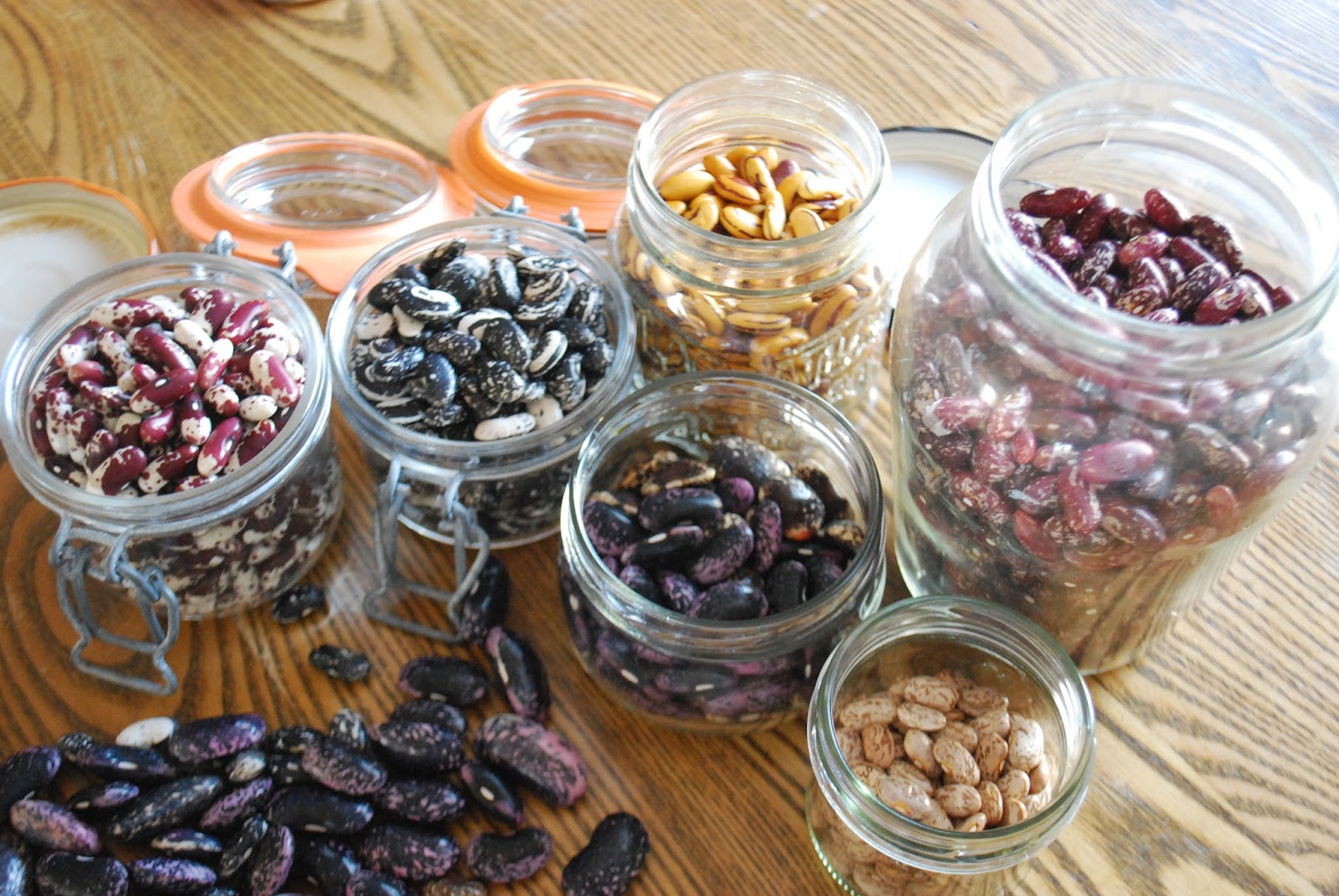
Some beans have given amazing amounts like Iroquois Cornbread (in the picture right above, it's the biggest jar with a burgundy bean stripped with thin cream lines), others in smaller quantity, like GaGa Hut Pinto (smallest jar - just below the biggest - with cream beans spotted with coffee colored marks).
Up and left: Iroquois Cornbread ; Up and right: my two favorites of this year, the black and white beans are called Flagg and the burgundy and white spotted like little cows are called adequately Jacob's Cattle. Down and left: Pepa De Zapallo or Tiger's Eye ; Center-down: GaGa Hut Pinto ; Down and right: a mix of Painted Lady and Scarlet Runner Bean.
Of all the beans, Iroquois Cornbread have given the most followed by Flagg and Jacob's Cattle. Iroquois Cornbread and Flagg are climbing varieties (even thought Iroquois was mentionned as being a bush bean, it really expanded everywhere and climbed wherever it could). In contrast, my little cows (Jacob's cattle) are a real bush variety, very early to harvest: it was harvested second after Pepa De Zapallo, these are the earliest I've ever seen a bean ready. The Flagg variety are quite late but not as much as Scarlet Runner and Painted Lady. These last two, I had to harvest most fresh, else I would have lost them to the frosts. The picture to the right shows the last beans harvested this year, most of them are Scarlet Runner and Painted Lady. What can I say: the season here is just not long enough to really have them at their optimal, but they are still amongst my favorites! The plate on the right holds the smallest green beans, those that really didn't mature enough. I'll have to freeze them otherwise I'll loose them: they wouldn't dry properly. The bottom-most plate holds many different stages of maturity that I haven't classified yet. The two last plates have Scarlett Runner and Painted Lady that may dry well enough left on the counter. I should note that excluding these two varieties, my other beans have all dried well directly on the plants and you get a better quality of beans when they have the time to do so: left to dry on the counter out of the pod, the quality is diminished.
Where did I find all those wonderful varieties, you may ask? From this marvelous canadian producer of many heirlooms. Heritage Harvest Seeds have a section specially dedicated to beans! A dream for me! Comes also from them my giant nasturtiums I planted this year and this beautiful Morning Glory (left picture, variety called Clarke's Heavenly Blue).

Strawberries between wooly thyme and gold origano.
Other successes include, as usual, berries. It always start with strawberries of which I have two varieties. The variety pictured on the left lasts 3 to 4 weeks and gives me, at its peak, a bowl like this every 2 days or so. There's also the alpine strawberry that almost tastes like strawberry flavored candy. That one last the duration of the season but does take a breather while the heat waves hit in August. It doesn't give me much strawberries each time, but it lasts, so it can be forgiven. On the heels of the last remnant of strawberries, I can start the harvest on the juneberries and they last about 3 to 4 weeks too. Of course, the quantity of these harvests starts slow, peaks up and decreases during that period. It's visible on the pictures below: the juneberries really pick up while the strawberries are waning.
Linden flowers, red currents (the 3 small branches covered in red, shiny berries, hanging on the bowls' rims), a big bowl of juneberries and a small dish of strawberries.
A week later, a nice bowl of juneberries was harvested along with only a handful of strawberries. Following the juneberries, golden raspberries that I'll be able to harvest until the frosts of October - even November on some years. There's a waiting period between the last of the juneberries (the end of June) and the first of the raspberries (middle-end of July). It's also worth mentionning that - like the alpine strawberries - the raspberries take a breather too, around the beginning of September. After that, it's only a handful here and there. When I get berries in such a small quantity, I tend to just eat them right there on the spot, while gardening. But sometimes, I'll take them inside and use them differently. Check out the next pictures:


For decorating home-made chocolate pudding.

A couple of golden raspberries on maple-syrup drenched waffle, accompanying a latte and home-made ricotta, makes for a very special breakfast!

Of course, the raspberries offer at first a good amount of fruits! And this year, even my blueberry plants gave me some fruits: not much but still a lot better than the previous years. Hopefully, next year, they will really step up their game!
Tomatoes produced quite well, all things considered, since they didn't have the prime spots they usually get and like.
Tomatoes harvest (the big reds are called Pink Vernissage; the small orange ones: Cherry Orange) and a bean harvest of Iroquois Cornbread, all of that stuck (for the photo) in my grape vine which will hopefully produce next year.
I didn't plant my favorite tomato variety and I should have: it makes an amazing amount of fruits compared to the 2 varieties I used this year. My favorite is called white currant but this year, I used old seeds I already had of Pink Vernissage and cherry orange instead of buying new seeds. And since they didn't have any prime location, with the best sun spots, I mostly collected green tomatoes as you can witness below.
Red and yellow potatoes in the basket (this is not the complete harvest), with the only winter squash, a big bowl of green tomatoes with a yellow apple from the market (hopefully, if the old trick works, the apple will help the tomatoes to redden) and of course a lot of beans! The tiny orange-yellow flower on the left of the picture is a calendula, from which I keep the dried petals to make a winter balm that's useful against eczema.
Here's the mid-season harvest: a couple of potatoes, some tomatoes, a handful of calendula flowers and lots of beans. The top of the plate holds the white and black Flagg, the cream-stripped burgundy that takes the most space is Iroquois Cornbread, the big brown and cream at the bottom-right is Painted Lady, the black and violet is Scarlet Runner and the 6 - yes, count them : 6 - tiny ivory and coffee ones at the top-left are GaGa Hut Pinto. Notice between the plate and the flower bowl a handful of discarded beans. They have been discarded because they are either split, discolored or haven't matured well. It's normal to find some like that in an otherwise good harvest.
Some of you may notice another strange thing: Painted Lady beans are supposed to be orange and brown. Mine come out cream and brown, althought I buy new seed stock each year: seed stock that arrives perfectly orange and brown. But reliably each year, I end up harvesting Painted Lady cream and brown here. Is it because of cross pollination? Or maybe there's a special trace-element in my soil? I have no idea. They are still delicious, regardless.
On the left, the yellow, parasol-shaped flowers of dill, the bright-yellow flowers of Bitsy daylily on the foreground, the green mass of anis hyssop that has yet to flower in the center and the elegant pink and white heads of milkweed on the right.

Failures?
Every garden I know has failures at varying degrees: it's just the reality of the gardener. This year, the peach tree didn't produce. We'll see next year. The cucumbers started well enough, but there was one draught I didn't address. The result was that one half of my cucumbers were half-mature, the other half were small difformed stubs. The broccoli have grown well but somehow tasted awful, so I didn't even bother to harvest them.

After all these years, surprises must be sparse?

Not at all! Weird surprises, too. I almost placed dill on the failures' list this year, because just as the flowers were going full bloom, (exhibit A, picture above) strange cocoons appeared on the floral heads, warping their stalk and preventing the seeds to develop (the very seeds I want to harvest, after all). And let's say it doesn't look enticing either. But since dill is almost a weed in my garden year after year, I didn't fuss too much about it. I did ask the folks at the Montreal Insectarium however, as I do sometimes. I placed some cocoons in a ziploc bag, in case the experts ask me for them if the pictures weren't enough. While waiting for their answer, one of the cocoon opened up revealing the morphed creature! Want to take a guess at what kind of insect came out of it?

It's Propylea Quatuorcimpunctata,14-spotted ladybird beetle or apparently... P-14. It's a variety that eats aphids and other soft-bodied insects. And despite their cocoons, my dill bounced back and I could do a decent harvest of seeds.
Dill seeds harvest and in the background, a fluffy belly.
 Another funny surprise was the amazing quantity of snails I found everywhere! I noticed them last year of course, but this year, I litterally had to be careful where I was stepping and what I was harvesting! I managed more than once to bring a snail inside while harvesting - for example, basil on one occasion.

As a closing comment, I'd like to come back to the fact that in a world where performance seems to be the only thing worth of measurement, where failure is seen as a personnal flaw, I want to mention that those criteria simply shouldn't be applied to gardening and our work as gardeners. If it was the case, not a lot of us would take time doing it, since gardening, either by our hand or mother Nature will result in some amount of failures. It is perfectly normal in a world that's ever-changing, that's always in evolution. Some plants will wane after a while, to be replaced by plants that wouldn't have managed it at first. It's nothing to take personnally or as a gradation of our success, it's just there to be observed and we have to respect that fact of life.


mercredi 30 septembre 2015

The cheerfulness and bounce of nasturtium

Cet article en français.

Hélène :
We praised the daylilly flower, we described the qualities of the borage flower, and even whispered here and there about the sweetness of the violet. Even a linden tree and its flowers captured our attention. In this article, we will focus on the vivacity of a pretty annual: the nasturtium (Tropaeoleum Majus).

Of all the edible flowers, this one has the boldest flavour: the flower tastes of pepper!

Louise :
Nasturtiums are plants that are fun to introduce to kids. Their big seeds are easy to manipulate for the kid's tiny hands, their flowers are showy and abundant, their leaves have a round, buckler shape that makes them very fun and easy to identify.

All parts of the plant are non-toxic. However, be careful with the seeds you buy: some companies spray them with a fungicide, so don't eat those seeds and wash your hands after handling them.

But apart from that warning, the entire plant is edible, from the flower, to the stalk, to the leaves, to the - yes - seeds. Those seeds, when still immature, are green, as big as a pea and taste like pepper - a stronger flavour than the flower or any other part. The seeds can be marinated and can replace capers, by the way.
At the end of September, all the plants have a hard time staying green. Not the nasturtium. It is still producing loads of flowers. Here's a giant variety of nasturtium that's overflowing its attributed space, spilling on the stone walkway and climbing up the milkweed that stands behind. It buries almost completely the lavander and if the gardening season wasn't so short, I would probably lose my watering can and my son's toys under all that greenery!

In this container, two varieties of nasturtiums, one with variegated leaves.
Nasturtiums have a wide range of styles, from dwarf varieties (reaching 30 cm - 12 in. high) and normal heigh varieties, to giants or even climbing ones (reaching 180 cm - 6 feet high). The flowers also have a wide variety of coloration, from very pale yellow to a deep red, going through bright oranges and apricot. There's even some with variegated leaves, like the picture above.
A red - very red - Nasturtium!


Nasturtium is also a marvel in the garden as a companion plant, where it's a favorite of aphids (once the aphids are on this pretty plant, they tend to leave other plants alone, the nasturtium acting as a sacrificial plant). Nasturtiums also have the reputation of driving away some pests. It can be placed near other vegetables but it has a good history being used with tomatoes, cabbages, radishes and zuchinnis. Some gardeners use her at the base of fruit trees, too.

As mentionned in a previous article, I don't plant a lot of annual flowers in the garden, but nasturtiums are the exception because they have so much to offer!       I always end up with about half a dozen, sprinkled here and there.

From the same seed packet, flowers come in a fiery orange shade or a sun bathed yellow.
 Hélène:
As for me, nasturtium are everywhere in my garden too. Directly in the garden beds but also in containers. Often, I don't even have to replant them, the seeds seem to be hidden everywhere and sprout easily here.
Here's a climbing variety - or should I say crawling?
I love to add the flowers to salads. Their bold colors make for a festive plate that would otherwise look drab. And that peppery taste! Speaking of which, I recently worked a lot in the garden and kept bruising the multiple nasturtium plants I have: the air was peppery - of course not enough to make me sneeze like real pepper would have done - but the perfume was conspicuous and very pleasant.

A wild fight here between the potato plants and nasturtiums. Who will win this round?

Above all: while, with autumn at our door, everything seems to be on death row in the garden, the nasturtium picks up steam and looks more radiant than before. Actually, summer heat takes its toll from it - but as soon as there's a cold spell, it seems to perk right up. That's when this special plant produces a final explosion of showy flowers as if to wave a final goodbye!
Potato harvest right next to the nasturtium. Althought I ruffled it some while collecting the potatoes, it didn't seem to mind much!

mardi 18 août 2015

The daylily, a rainbow of possibilities

Cet article en français.

My various daylilies offer many different petals, grouped here with other flowers and herbs (the blue star-shaped borrage flower, the ciseled leaf of dill, the smallish five-petals, pink and magenta flower of mallow (Malva Sylvestris) and its leaves (right, bottom corner of bowl), parsley at the back of the bowl and peaking in the left, bottom corner of the bowl, the big, round leaf of nasturtiums and its flowers, buried under the rest), all of this for a delicious salad.
Hélène:
We already produced an article on the edibility of daylilies leaves, mentioning quickly how the flowers were also edible, but we never got the chance to talk about it adequately. How unfortunate! Since the flower is so ephemeral (it is called a DAYlily for a good reason after all) I feel less guilty using them with abandon. 

I make entrées out of them, stuffing flowers (minus their pistils) with pepper Boursin cheese and closing their petals over with strands of garlic chive. I do have to eat them in small quantities; if the leaves can give you belly cramps, the flowers - however weaker than the leaves - can still cause pain. Moderation tastes better, what can I say. It's also worthwhile noting that dark-hued flowers tend to have a slight metallic taste.  Paler flowers are thus preferable for consumption.
 I don't use them just for their taste, however! Daylilies come in such an impressive array of colors, forms and sizes that they can also be used for a simple fancy: dressing up your hairdo! It doesn't last an entire day, unfortunately, but they do make me smile!
...To the most extravagant hairdo.
From small and simple...


Has I said, so much choice is available when it comes to daylilies, surely some of them will enchant you too! And it's one of the easiest plants you can grow in Quebec, so much so, the species 'Fulva' even grows wild. Here's a small selection I managed to cram in my small, suburban homestead:
Elongated or round petals, contour either straight or frilly, from a deep red to a peachy-beige (going through dark violets and without forgetting the true yellows) even thought the flower fades so fast, daylilies do please!

vendredi 10 juillet 2015

Lime tree, how extraordinary!

Cet article en français.


Hélène:
Did you know there's a tree which's leaves can be used in a salad? And the flowers can make one of the most exquisite herbal teas?

Enters Tilia, in latin (Lime, Linden or Basswood in English, tilleul in French - the name Linden comes from the germanic source Linde), but my little name for it is perennial lettuce, since the young heart-shaped leaves are delicious and - contrary to the standard annual lettuce - these leaves come back year after year without any input from me. That's a lot less work to do in the garden.

Linden and man have a common history that goes way back. In Europe, the Linden tree has been one of the symbols of the French revolution. He is, with the oak, the tree of justice where juristic procedures were held in its shade. Also the dance tree for the newlyweds, it's a symbol of friendship and celebrations, it's even on the coat of arms of a city in Alsace called Linthal (note the german source in the name). The smell of the flowers was revered by the priesthood as a sacred symbol too, so they planted the trees around their churches.

Homemade herbal tea  with linden flowers and juneberries from the garden on the side. What a perfect four o'clock tea break.

 I learned about linden herbal tea through the Quebec enterprise la Courtisane. At the time, what charmed me most of their product line was the simplicity of the ingredient list, in this case just one: linden flowers. It's still today one of my favorite, a divine but smooth flavor and a beverage that has a slight pink hue. The flower is somewhat strange: it's waxy on the touch. Its perfume is apparently quite tempting for various pollinators (you thus have to wash the flowers quite well before drying them!).

It is worth to mention however that -according to the French Wikipedia (note that this information is not on the english version) on Linden tree and a further google search - there are a couple of varieties of lindens that are toxic for pollinators, apparently bumblebees especially, so select a variety that is alright for them, since the linden tree can be a major source of food when good. During the short summer flowering, one can ear the buzz of all the insects feasting on those delicious trees!

If you want to harvest your linden tree to make herbal tea like me and Louise do, you may collect only the flower, but you can also collect the unopened blossom, the fruits, the floral ramifications or the entire bract (those yellow, slim "wings" at the base of the ramifications of flowers). According to my experience, the unopened blossoms and fruits are harder to dry out properly but are good for tea too. The linden is also perfect in a blend: I bought a delicious herbal tea at the Fête du chocolat de Bromont, a mix of rooibos, linden flowers and citrus.

Linden flowers ready to be dessicated in my dehydrator.


My linden tree is still very young : planted here in 2013, it was two or three years old. But it's already giving me plenty of flowers and the leaves are delicious. Here it is on the left with lamb's ear (Stachys Byzantina), daisies and a dark-leaved variety of Heuchera (the purplish leaves at the foot of the tiny tree).

When it grows, the linden tree will take a conical or rounded shape, depending on the variety. The shade a linden tree makes is dense and it can grow up to 35 meters, so think about it before placing it. I hope mine will make some shade for the front of my house, since it is exposed to South-West sun and therefore gets really hot inside during summer heatwaves..


My linden variety is Tilia Americana "Redmond" and I can vouch for its good taste, from both leaf and flower. Other good varieties for consumption are Tilia Cordata "Greenspire" and the Tilia X Europaea, that last one's recommended by Martin Crawford, leader of the forest gardens movement. If the subject is of interest to you, Mr. Crawford wrote two excellent books about it: Creating a Forest Garden and How to Grow Perennial Vegetables. Althought the books are set in a Southern British climate, both are still of incredible value even here, in Québec

For consumption, young leaves are preferable, as mature leaves become tough- even thought they are still edible. They can of course be used in salads, but beyond that, they can be used in soups and stews. Their mucilage thickens the liquid in which it is added. Of course, young leaves are plentyful in springtime, but you may still collect them later in season since the tree generally continues to put forth new leaves. The harvest takes longer and is somewhat lessened, though,  since you have to find and select them among the others.

That true green hue shows the maturity of the leaves. 
But the smaller ones in there are still tender.

 Those pale-green leaves are more recent, thus, they are more tender.
Those red protuberences are caused by the lime nail galls
They don't affect the health of the tree
but if you'd rather not have it, 

there are natural treatments for it.
Louise: 

I agree with Hélène: lime leaves are scrumptious. In salads, I use them with other greens. I put them in sandwiches and berry smoothies. When I work in the garden, I nibble on some, whenever I passby the tree. I noticed that about ten leaves as a snack can sustain me until the next meal. 

No wonder since they are a good protein source. I haven't tried it yet, but one can apparently make a very nutritious green flour out of it. One kilo of leaves can make 300g of flour. And there's yet pestos to try, blossoms to taste and I have to find out if the leaves can be frozen for winter use! 

In permaculture, the linden tree is particularly appreciated since it's uses are many.
- It's an ornemental tree that can also make a good windbreak and that can support grape vines climbing on it.
- It can resist both drought and inondations and also windstorms. Some varieties are more resistant to snow and icestorms.
- The leaves can be given to cattle. I know from experience that lamas and white-tailed deers are fond of them and they can even eat the young branches.
- The tree is a dynamic potash and calcium accumulator. Therefore, the leaves it sheds in autumn are very welcome either in compost or as a mulch.
- It can support pollarding, and even coppicing, two woodland management techniques widely practiced in Europe, but not so much on the American continent. Actually, these techniques have the effect of prolonging the tree's lifespan. Those techniques, when practiced every 2 to 7 years, encourage the growth of low branches, making the harvesting that much easier. Done less frequently, the branches become longer and bigger. Those techniques may inhibit the flowering, though.
 - The biggest branches can be used as firewood, posts, perches or even mushroom logs.
- The smaller branches are flexible enough to be braided for baskets.
- The wood is further used in cabinet making and instrument making. It is an easy wood to sculpt.
- From the inside bark, rope, carpet and even cloth can be made.
- The sap can be collected just like maple sap can be. It can be drinked as such or boiled down to syrup, but there is little sugar in it and so, one needs to collect a lot of sap to be able to make it into syrup.
- It has a lot of medicinal proprieties and is used in perfume too.

Hélène: In conclusion, this tree we can eat and drink, that offers plenty of shade, that's so beautiful and shares such a history with mankind, can it be said that it is such a gift from nature?

If the linden tree and daisies are both friendship symbols, my frontyard becomes quite inviting! This small flowered isle is also a nexus for a wide range of insects that visit a trio of loved-by-pollinators flowers: lamb's ear (the gray spires with purple flowers), the linden flowers (in the picture, they are at the young fruit stage) and the daisies.

dimanche 31 mai 2015

Money doesn't grow on trees, therefore...

Cet article en français.

Louise :
 ... therefore it's a very good reason "not to throw away your Lamb's Quarters" (aka Meldes - Chenopodium album in Latin - Choux Gras in French, Cenizos in Spanish). This old saying comes from the fact that this very common weed being perfectly edible, in past times, any gardener who eliminated it from its' garden beds was considered to be wastefull.
By mid-May, the garden is green again.
Stonecrops (Sedum) and white violets (Viola alba).
Note the few dead leaves that still stick out here and there.


Certainly, I cannot brag about being the queen of thrifty gardening, but just like yourself, probably, I developped a few ways to spare money when I garden. It can be a clever trick or a very simple but efficient idea. Each time, though, it takes place within a general approach which reflects my personal experience and my values, my own evaluation of my gardening practice and habits. This permits me - or not - to make substancial economies on the long run.

Obviously, our own personal way of viewing gardening will give each of us very different results, from a very expensive garden to another one built practically for free. It depends on our choices and priorities. We know that we succeeded when our goals are reached and when the results match our values.

I remember reading in a gardening magazine an article presenting a gardener who succeeded within only a few years in building a wonderland even if he invested only a few dozens dollars a year. All his constructions were built from recycled, free material (pergola and small bridge included). He used to borrow every gardening tool from friends, neighbors and family (at times in exchange for help). He made his own compost and acquired every plant or shrub, seed or cutting through donations.

Somewhere else, another gardener may pay good money to hire a landscaping company to create from scratch the garden of his dreams. Furthermore, the same company may offer him to take all the maintenance in charge, in exchange for a monthly fee.

My gardening expenses

This spring, in order to prolong by one more season the
life of this worn wooden half-barrel, I recycled two 
potting soil plastic bags, I cut them open and covered the
sides of the half-barrel with them, black side against the
wood. This should keep the soil inside while maintaining 
a more acceptable humidity rate for my plants.
Well, they're in between those two extreme cases. When I stumble on a trick which can save me money and is easily implemented, I jump on it.  There was a time when I invested a lot of money in buying ornemental plants, but at the same time, I've always been thrifty on gardening tool expenses. I do all my work simply with a shovel, a couple of trowels, good pruning shears and a sturdy wheelbarrow. I complete this list with long-handled pruning shears. Only recently, we bought a chain saw and a wood shredder to take care of our trees. Before that, we simply worked with manual tools and a lot of elbow grease. 

Speaking of trees, since the beginning I've always relied on their sculptural form to give dimensional structure to my garden. Therefore, I never had to invest much in costly manmade elements, with the exception of our garden shed, which is quite fancy. To start my seedlings, I bought a used metallic lighted shelf unit of 3 shelves, for 100$. I know, I've been very lucky to find such a bargain. I also built another two-shelves unit, with two fluorescent fixtures for about 70$.

I estimate that my seedling operations cost around 27 cents per plant (15 cents for Jiffy peat pellets - ideal for the lazy gardener - and the rest for potting soil when my seedlings need repotting). In this calculation, I don't take in account the electricy cost - it's minimal - or the purchase of the seeds, which may vary a lot (from 1 cent or less to nearly 1$ per seed). More and more, I harvest my own seeds, but I still buy a lot of varieties and I don't deny myself that luxury.

I have numerous windowboxes and pots, but I also reuse various plastic pails and other containers whenever they suit my needs. I make my own compost, but not in sufficient quantities, so I rely on other tricks, but we'll come back later on this subject.

So now, on the topic ofa (relative) frugality in the garden, here is a general reflection through a few of my gardening habits.

Practice number 1 : reduce plant purchases
It is well known that we can acquire new trees and shrubs as well as diversify plant species in our garden by exchanging seeds, cuttings and divisions. Gardening Clubs, ads on billboards and internet sites are good resources to put gardeners in contact with each other.

Hélène : I suscribed to a site, called Plantcatching. Two weeks ago, I exhange plants with someone from my neighborhood. I invite you to go take a look.

Louise :
When we start a new garden, we often have to start from scratch, therefore and logically, we have nothing to barter for plants ! Well, not exactly. With a pair of hands and some enthousiasm, we can offer our services to rake, weed, plant or turn the earth in exchange for divisions, cuttings, old pots, compost, etc. If we offer to assist an old gardener during his or her gardening chores, we don't risk to displease him or her because this person is there to supervise us closely. Moreover, we can learn a few tricks from a fellow experienced gardener, especially if we are a novice. 

We can also bring back new plants or seeds from wild harvesting expeditions. This is how I came back with a few specimens of Forget-me-not (Myosotis), Herb-Robert (Geranium Robertianum) and Wood Violet (Viola Odorata). Be careful, though, to respect private properties and laws protecting threatened and vulnerable species. But sometimes, harvesting is the way to protect a species. For instance, a friend share with me some bulbs of wild garlic that she had harvested in a nearby wood just a few days before the bulldozer came in to raze the site to the ground for a new construction project. 

Hélène :
Another way to reduce  plant purchases is to allow some volunteer plants to establish themselves in our garden. It's always prudent to duly identify them before. Each spring, I discover a variety of spontaneous seedlings where they are unexpected. Sometimes, they give me  rather surprising results ! For example, squirrels brought in a few different bulbs, and now I have crocuses that I never planted myself.
A young Leatherwood (Dirca Palustris), born from a seed. It will probably replace its parent, from which we can see a few dead branches on the photo, because it outgrew its location, partially blocking the access to our garden shed door. Leatherwood is a shrub indigenous to mixed forest in the Eastern part of the North American Continent.
Louise - Practice number 2 : to bet on the "winning horse"
We can save a lot of money when we don't persist on trying to grow plants ill suited to our garden's environment conditions. It took me about a decade to fully understand this lesson.

Not to say that I have anything against an adventurous and innovative gardener who would finally succeed in growing bananas under Quebec skies. On the contrary, many similar new advances (but maybe not quite so bold) came up from trial and error. But then, you must be willing to spend a lot of energy, time and even money, without any guarantee of success whatsoever. 

We can look at what species of plants our neighbours have good success with. Not  very original, maybe, but usually, it increases our own chances of success. Note that, even there, nothing is totally foolproof. For instance, I could show you, in certain neighbouring gardens, big, nice, healthy patches of lupines. But in my garden, they start to die slowly after their first season and end up disappearing. Hélène asks me if my soil would be too rich (this plant prefers a poor soil). Possibly. I'll have to think about it.

Then, we can learn to read and understand correctly the plant's tag, to check wether it has a reasonable chance of survival in our garden. Light, humidity, pH, zoning are, among a few others, important factors to consider before purchasing a new plant or tree. Note that si you ask, in a garden center, for classic plants which proved themselves reliable, you will have a much better guarantee of success than if you indulge in the lastest novelty of the year.

Personnally, I indulged into various kinds of trials with the years. I often moved plants from spot to spot to try and find a better suited site for them. I also did try four or five times before giving up on a species of plant, sometimes with success, finally, but other times, it's been a repeted failure.

Practice number 3 : certain plants are more profitables than others
Certain plants, provided they feel satisfyied with their location, will give us more bang for our buck. 

Daffodils are among the happy plants of my garden :
they cope very well with humidity in springtime, take 
in every sunray before the neighbouring trees leaf out
and settle happily in the dryer summer soil for their
next dormancy period. On the other hand, 
after a few years of bulb multiplication, they crowd
too much and stop blooming. Time to divide them.
Planted in a ring around a young tree, they're supposed
to deter rodents from coming munch on their bark.
Hélène also read that they can act as a weed barrier,
but observed a rather poor performance in her 
own garden. 
  - It's the case of perennial plants, since they live during many years and/or strive to expand and reproduce. A majority expand their root system or send in every direction long creeping stems, and in addition, some set viable seeds. 
Gardeners can also help their expansion by dividing clumps or by taking cuttings to make them root. These various possibilities of reproduction render a perennials more profitable than annuals, despite a higher price tag. Further more, established perennials demand less maintenance than annuals. For example, a hosta may live 60 years and to multiply it, we can divide it every three to ten years. Plus, many varieties of hostas are considered a vegetable by japanese people .
Careful though, some perennials don't easily tolerate transplantation. It's the case of the Gas Plant (Dictamnus Albus), which presents enough aesthetic qualities to counterbalance this fuss, its most precious asset being big showy flower spikes sported high in May.

 - Certain annuals or biannuals can also reproduce under our latitudes. They seed themselves spontaneously or, at least, offer us their seeds to start them in the following spring. Forget-me-not (Myosotis), Herb-Robert (Geranium Robertianum), Wood Violet (Viola Odorata), Mayweeds (Matricaria), Johnny Jump Up (Viola Bicolor, Viola Tricolor and others) and Himalayan Balsam (Impatiens Glandulifera) all come from the first few plants I brought to my garden and they come back faithfully every year. They are even more or less  invading, if I don't cut their flowering stems before they set seeds. 

Crocuses arising from the leaf mulch in the
first days of spring is indeed a happy sight !
Their patches expand a little more with
each passing year. 
   - Certain bulbs multiply themselves readily. Among others : Daffodils (Narcissus), crocuses (Crocus), Glories-of-the-Snow (Chionodoxa), Siberian Squills (Othocallis Siberica or Scilla Siberica), native tulips like Tulipa Greigii and Tulipa Tarda. Within a few years, those species multiplied themselves by 2, 5, 10 or even more. My Siberian Squills, for instance, formed a dense carpet, 30 square foot (10 square meter) wide. Other bulbs degenerate or don't multiply. Hyacinths (Hyacinthus) and  many varieties of hybrid tulips fall into this category. My clump of (Galanthus Nivalis)barely begins to expand a little after a 20 year residency in my garden ! And regarding the hybrid tulips, I finally gave up spending good money for a one-year-only good show.

Hundreds of Siberian Squills are all born
from the dozen bulbs I bought years ago.
The nice thing is that, by falling back in
dormancy soon after  their spring flowering, 
they leave the space to other perennials 
for the rest of the season,
as part of their natural cycle.
 - There are also trees and bushes that will reseed themselves or produce off shoots that can later be separated from the mother plant. We can also obtain a new tree or bush by the techniques of layering, grafting or rooting cuttings.

- Finally, any plant  that cumulates more than one function will be automatically more interesting. For example, if you want a bush, why not chose a  Gooseberry (Ribes Uva-Crispa) for its berries and because its blooms attract pollinator insects, or a Gumi (Eleagnus Multiflora) for the same two reasons plus its ability to fix nitrogen in the soil ? You have enough space to plant a tree? Lindens, aka lime trees and basswoods (Tilia) offer a very aesthetic silhouette, heart-shaped leaves, a good capacity to adapt to urban environments, a beautiful, delightfully scented flowering, you can dry those blooms to make linden tea, you can eat its young leaves any time of the year (lime trees are also called salad trees), a green flour rich in protein (with the dryed and ground mature leaves) and it provides you with soothing shadow. How about that ?

Practice number 4 : leave it in place
We can save a fortune in both commercial mulch and fertilizer, while diminushing, if not eliminating watering, simply by leaving in place vegetal debris instead of sending them to the dump or piling it on the compost pile. All we have to do is to keep our bags of autumn tree leaves and to leave in place aerial parts of our plants during autumn (except for plants that would show signs of sickness, of course).

For many reasons, lack of time in fall not being the least, I prefer not to cut back the dried vegetation before the following spring. In our last article, you can see the sculptural effect of this practice during winter. The huge "bush", to the left, is a non edible legume perennial : Blue Wild Indigo (Baptisia Australis).All parts of the plant, including those dry erect stems, trapped a good quantity of nitrogen, an essential fertilizing element for vegetation.  I cut them in short sticks, creating a mulch even more nutritious than usual.
Here is the same Blue Wild Indigo,
photographed from another angle
and almost completely cut down.
I spread its mulch wherever it suits
me, sometimes quite far from the plant,
in order to feed other parts of the 
garden.
If you don't like the untidy look of such a mulch, you may either wait for the perennial vegetation to grow through it and finally hide it completely, or use better looking commercial mulch in front of your beds and relegate your vegetal debris to more discreet spots, like at the foot of shrubs standing further back and around plants that will hide everything under their large leaves or behind their high stature. Plants producing multiple stems are also good for emprisonning dead leaves and other debris on the spot, preventing them to fly in the wind.

It's also good to know that not all vegetal debris are equal in fertilizing value : legume plants like Blue Wild Indigo, Lupines and Clovers accumulate nitrogen, while other plants gather greater amounts of a variety of nutrients (like Comfrey, Borrage and Dandelions). Those plants will diminish the need for fertilization and for watering. Therefore, next time you pull out a dandelion, why not spread it over the existing mulch and let it  die in a remote corner of the garden? Just make sure to remove any flower bud or spent flower and to throw them in the garbage, because the plant will spend its last bits of energy to try and produce viable seeds. Even a cut spent flower will sometimes succeed in maturing enough to do so. Dandelions are a tough species !

Here again is the same bed, three weeks later. In a few more days, nothing of this natural mulch will be left visible from the street.
I know that many persons will protest that leaving vegetal debris around the plants may increase the risk of spreading diseases and pests. It's true, except that in my personal experience, only if negative factors are existing in the garden. For instance :
- When a specimen is in dificult conditions for its species' requirements (zoning, sun, cold or heat, pH, type of soil, humidity, etc.). If a plant grows in favorable conditions, it will be able to defend itself against sickness or pests, because it will have the energy necessary to do so. Moreover,  if your soil is healthy, it contains a good number of micro-organisms (small bugs and bacteria) and beneficial myconiums (kinds of fungi) that create a symbiotic relationship with plants, protecting them against diverse attacks and providing them with the exact nutriments that they need, and moving them from sources out of their reach, all this in exchange for a little of the carbohydrates produced by the plants.

- Within the same order of ideas, each time we disturb the soil by plowing it, we kill a good proportion of those essential organisms and myconiums. Again, with perennial plants, the need to disturb the soil doesn't present itself very often once they are established, and the soil has a real chance of balancing itself and attaining its natural richness and fertility. 

 - When a species is not surrounded by a variety of other plant species, or when it's cultivated in monocultures, this represents another negative factor. Years ago, I once visited a garden containing only a lawn (the number one monoculture in America, by the way) and hybrid tea roses. The poor things were planted in line along a picket fence against the public sidewalk. Their soil was exposed to the elements, without any mulch to protect it. This garden got together many problematic conditons around a species of plants that have the reputation of being fragile and finicky under our northern latitudes. Thank God, the gardener who took care of these roses did it with a real passion and she spared no effort to pamper her prized specimens (nor did she spared chemical sprayings, by the way).

   - When a gardener uses pesticides against the smallest bug, he starts a bad chain reaction more often than not, simply by killing also a number of beneficial micro-roganisms and insects along with the presumed culprits. The predators usually take more time to reproduce themselves than their prey, therefore a localized environmental imbalance is put in place, calling soon for another application of pesticide and soon provoquing a spiral of problems, frustration and recurring costs. Buying those pesticides one season after another represents an important expense.

Who said that vegetal debris and dead leave mulch made a poor fertilizer ?
The soil from this perennial bed (photo below) is black, light and rich. My plants certainly don't complain about it !
Another of my perennial beds, in mid-May. Since a few decades, I fertilize it almost exclusively with the thick carpet of dead tree leaves which fall naturally on it each autumn. By the following spring, most of my perennial make their way through this mulch on their own. The leaves dry out enough to get fluffy again. I noticed that numerous critters live under there. My guess is that they are partly responsible for this naturally occuring aeration of the mulch. At dusk, I can hear them making russling noises by their restless activity. When a plant has a little more trouble emerging from this thick carpet, I help it and move the dead material around its base. Bulbs (crocuses and daffodils, for instance) often need help, because they tend to pierce their way through the dead tree leaves and lift them up while growing. It's like they would try to poke their head through a T-Shirt that would be too small for them !
Practice number 5 : be curious
I could have mentionned it first : in order to make a satisfying selection of plants, we usually cannot escape it, we must invest time to educate ourselves. We need to gather information on any plant, tree or shrub that we want to bring back home as well as on the vegetation that is already there. A wise start is to find out their latin name, a much safer way to guarantee that everybody is talking about the same plant.
Personally, I think that the information found in most gardening magazines and gardening centers are a good start, for sure, but they are not always sufficient. Most of the time, their point of vue reflects a very traditional and commercial approach to gardening. Therefore, we need to forage a little further in order to find hidden vertues and flaws of each plant. As you already know, Internet opens a door to organic and permaculture gardening practices. Many gardeners also generously share their experience and certain organisations built lists of plants that are interesting from a point of vue or another.
My ungoing search for information lead me to invite in my garden plant species that are less usual, like this Large-flowered Bellwort (Uvularia Grandiflora), a beautiful, understorey indigenous perennial plant, giving bellshaped yellow flowers in springtime. Since it's considered a vulnerable plant, it's better to buy it from a reliable gardening center than to harvest wild specimens.Note that in this garden bed too, I left all dead vegetal material in place. I simply help a few plants to emerge, letting the majority of them work it out by themselves, like for this clump of Double Japanese Aster (Kalimeris Pinnatifida 'Hortensis'), in the foreground. This plant always take its time to emerge in the spring.
This kind of research is, for me, a good way to obtain knowledge for free, but it's always wise to double-check it. A good source to begin with is Wikipedia. For instance, this is where I found Chinese Mallow (Malva Verticillata) and where I learned that in China, it's considered primarily a vegetable. From there, I was able to confirm its edibility through a few other sites and then, to find two retailers on internet that could sell me some seeds.

Wishing you good discoveries !