GardenImages

GardenImages
Our gardens in many lights

lundi 30 septembre 2013

On the vertues of plantain and the cohabitation with wasps

Cet article en français.
Este articulo en Espanol.

Louise :

Most of the time, plantain (Plantago), just like wasps, raises negative reactions. On one side you have an agressive weed that sprouts everywhere and on the other an insect armed with a sting that can be potentially fatal to those who are allergic to it. Of course, this means war : They are both in the way, aren't they?

Broad leaf or Greater plantain (Plantago Major - Plantain Majeur in French, Llantén Mayor in Spanish). In this picture, it's growing through grass and clover. The seed stalks and broad, shiny, spoon-shaped leaves are clearly visible.

Human reality may appear quite clear but when it comes to the true state of affairs, it's not  as black and white. Plantain does have the unfortunate habit - unredeemable for some - of colonizing the manucured lawn with speed and zest. But it also as the precious quality of being there - anywhere - for first aid needs. Its formidable efficiency against stings from wasps, bees and mosquitoes and skin rash due to plants like nettle (Urtica) or poison ivy should make it a keeper.
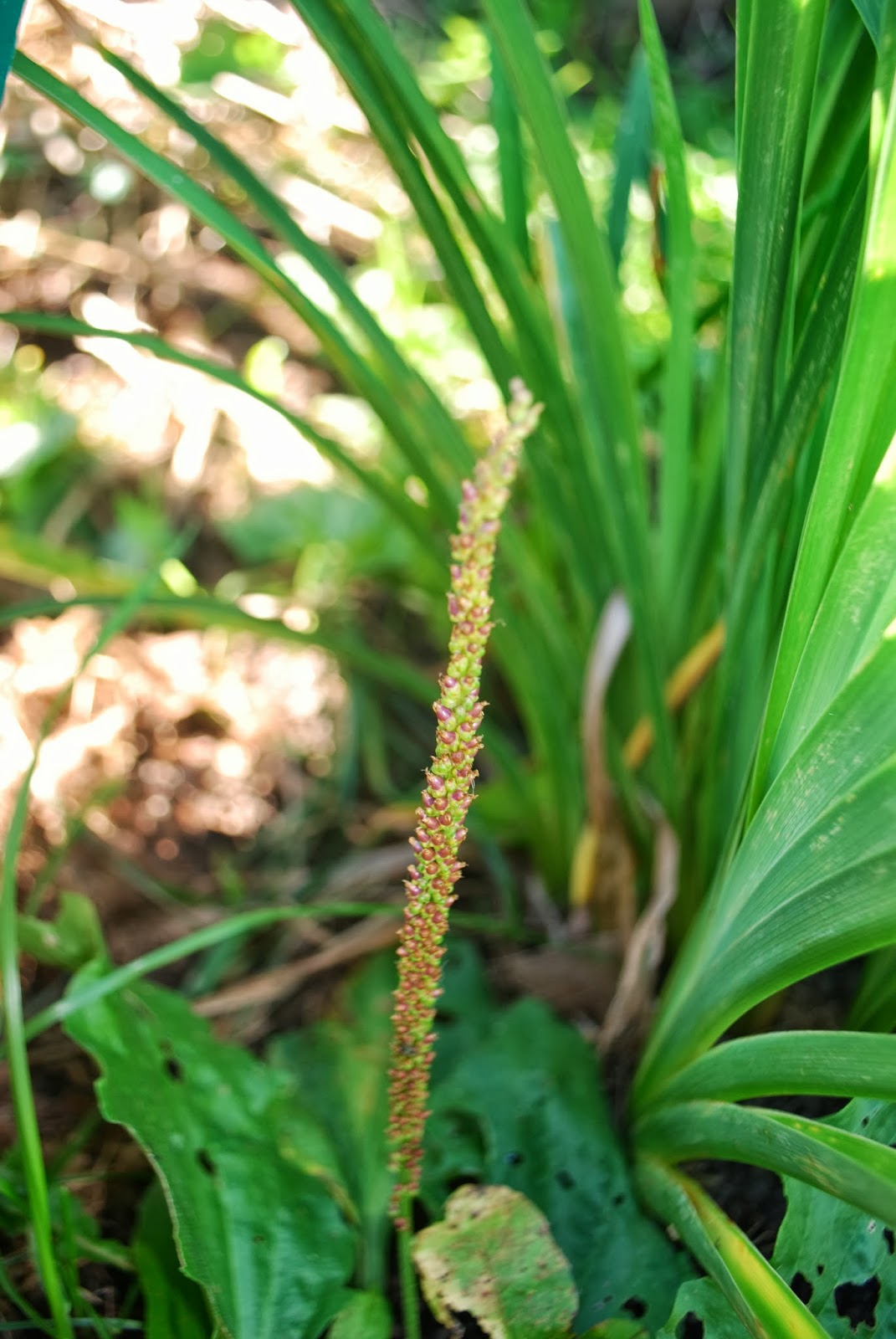
The stalk is full of green-brown seeds
almost ready for a potential
harvest.
I experienced it first hand this summer when I unfortunately stepped on an underground wasp nest. I managed to get swiftly far from it, thus limiting the damaged to only one sting on a finger. The next step took me searching for plantain. Since our lawn's got nothing to do with a manucured golf lawn, it was an easy enough task to locate a good plant. 2 leaves out, folded in 3 or 4, I chewed this and spat the crushed leaves on the sting.

The pain instantly diminished, to my relief. I kept the plaster of mashed leaves there for about 30 minutes. After that, the pain that was still there was benign, a simple reminder not to got back in the vicinity of the nest right away.

 Wasps do contribute greatly to the polinisation of plants, just like bees. Moreover, they are also fierce predators of other insects, insects that are considered pests by gardeners. Some species are regular hunters but others are parasitoid - laying their eggs inside the bodies of these pests (if you want all the gory details, check this link, meanwhile just know that the horror movie Alien was based on this type of insect behaviour). Of course, when we just received a sting from them, the only facet we can think of is how bothersome they are - still, this is where plantain comes to our rescue.
Hélène : Plantain is considered a weed  because whatever the kind of
environment - either the country or the urban life, it grows. In the streets
of Montreal, a simple fissure in the pavement (and there's so many) will
soon be host to, more often than not, this plant. See here how it's chummy
with dandelions, daylillies and my son's slide.
I am sometimes ambivalent on either killing a wasps nest or living with it. After all, there is always a risk living with insects that are so good at defending their territory. However, in all my family's history, even the worst encounters with them resulted in no more than 3 stings. Even that time where the human encroaching on the wasps territory had to make a mad dash for the pool, leaving behind the lawnmower at a still, its engine roaring right on top of the underground nest.

 So far, we destroy a nest only if : 
- It's underground in an area where there's lots of foot traffic;
- It's suspended to a structure and the occupants will feel attacked whenever the structure is shocked (like a door closing or someone's making reparations) or if there is a lot of foot traffic - human or animals - close by;
- The site is visited by children or guests; 

 I leave the wasps alone if their nests is in a remote location where not many people walk by.

 Reagarding plantain, its uses doesn't stop there. 
- The young leaves can be eaten in spring, either raw in salads or steamed like spinach.
- The leaves can be dried and rehydrated again for cataplasms, to heal scratches and cuts. The roots can be used in the same fashion.
- The leaves can be used to make an infusion, providing a vitamined herbal tea.
- The seeds can be harvested (althought it is a tedious job) and be ground and added to plain flour. Or you can give the seeds to birds. The seeds have a slightly laxative effect.
-  Finally, just keeping the plant right there in the lawn is a good idea since this plant accumulate hard to reach potash, calcium and sulfur, releasing these nutrients when it dies off, and thus, rendering them available for every neigboring plants. 

Hélène : Wasps have a reputation for being more agressive than bees. One of the reasons for that behavior is that bees, when they sting you, tear off their stinger, ripping up their abdomen, which cause them to die in the process. Not so with wasps ; they can sting you as many times as they like. This makes the bee less enclined to sting. She will only do this if she really feels threatened, it is indeed a last resort act of defense. That's why bees in my garden and me, we live together really well. Indeed, in my 5 years of gardening with them - this includes me leaning on their nests, which are located in the wood of one of my raised bed, to reach some part of my garden - I was never stung. I'm talking about it in this article.

This amazing nest, made out of chewed wood paste, is the residence of white-tailed hornets (or white-faced hornets  - Dolichovespula Maculata). Their heads have white spots and their abdomens are stripes black and white. The nest grew throughout summer, close to our garden. In winter, the only survivors will be the queen and her retinue of young, pregnant females. In spring the nest will be abandonned and each survivor (queen and princesses) will go out on a quest to establish a new nest. 

dimanche 4 août 2013

What's wise about sage?

 
Golden sage has vibrant colours and a delicate albeit elaborate pattern.
Hélène:
I love sage. The odor is divine, it's got - from one variety to the next - a colour palette that makes my heart sing and the texture of its leaves is so intricate I like to rub a leaf between my fingers once in a while when I garden.

A wonderful spring surprise,
the sage is coming back,
at the same time as tulips.
Autumn comes knocking on our doors soon enough however and I become sad about it. I realise I didn't use sage once this summer and I will soon loose a plant that is still bulky with aromatic leaves. You may think a rose is ephemeral, but for me sage is even more since I didn't use it as I should have.

Last Fall however, I read that sage was a perennial that lived down to zone 5. What? It's not an annual? Even thought the purple and gold variety have the reputation of being more fragile against cold than the standard green-leaves variety (salvia officinalis), here's something I didn't know at all. At the nursery, sage is sold with other annual herbs, so I naively believed it was an annual too. If you live in the greater Montreal region, you may just be able to grow sage for many years instead of buying a new plant every spring. For the winter preparation, I just made sure not to cut all the leaves of my plant as a fall harvest and covered it with a thick layer of dead leaves.

Bonus! I also made a great discovery in the kitchen after I had dried my purple sage leaves (my favorite). I dry them whole (the aroma keeps better than if I had cut it, in my experience and what I could find on the internet) and once dried, they are a cinch to reduce in powder form! A wisk of my mortar and pestle renders them thus and perfume my kitchen beautifully at the same time. I love to use this herb when roasting an entire chicken or in a soup! But there are many recipes out there, it's classically use on veal, for example saltimbocca, an italian meal.

My purple sage is wonderful with other plants in a container : Here it joins two heliothrope plants (hard to see since they aren't in flowers yet), cosmos and white marigolds. Sage can definitely bring an interesting decorative element to any container!


Here's a very interesting article on medicinal and culinary use of sage (it's in French, however). But here's another one in English. It contains very interesting informations about culinary uses. 

Sage is one of the oldest plants recognized for its medicinal properties, going back to the Greeks and even the Egyptians. It is used to gargarize against sore throat or canker sore, as a remedy against certain types of infections and more. The array of things it can apparently cure is wide (there's this french article that enumerates a bunch of them. For medicinal information in English, you may take a look here.). It was also used by the first nations to drive away evil spirits when it was burned.

Althought I don't personally use it medicinally, I find it a stellar beauty to bulk up a container!

Louise :
Sage blossoms are appreciated by bees and other pollinators. Humans can also appreciate the flowers by adding them to salads. And it is also possible to overwinter sage in zone 4 with the help of a thick mulch and a good cover of snow.

Sage is also called the sacred herb and Europe's Tea. It's indeed possible to make a very good herbal tea that as a wide range of medicinal properties. Finally, there's this provençal proverb : "Qui a de la sauge dans un jardin n'a pas besoin d'un médecin", stating that "If you have sage in the garden, you don't need a doctor."
In August, the sage in my containers is a superb sight. In the tiny glass jar next to it, there's the vibrant yellow flowers of my Mullein harvest, destined to be used in the fabrication of mullein oil against earaches.

jeudi 4 juillet 2013

My Windowfarm, or how to replace your curtains with vegetables

Cet article en français.
This article in Spanish.

Three cherry tomatoes slowly ripen under the
New York sun. Photo by Britta Ryley.
It's springtime, the dream of fresh plump tomatoes, nice basilic leaves and nasturtium flowers assails you, but you live right in the middle of a city. Not a square inch to quench your passion, not even a balcony ! Summer passes, fall is coming, the magic of harvesting has been someone else's dream come true. No problem ! You can always grow vegetables inside you home, all warm and cosy.


I started to write about my own experience in February 2012. I've been explaining that, in the heart of winter, I grew cherry tomatoes in potting soil, but also, I explained how I decided to build myself a Windowfarm. And you can do likewise. 

A window-what?
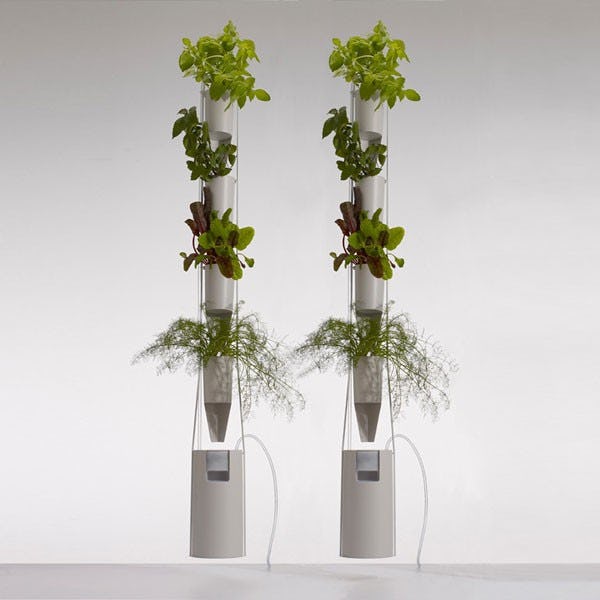
A Windowfarm (TM). It's a simple hydroponic system, installed vertically to take advantage of a window's surface to grow some vegetables, fruits or herbs, instead of non-edible, traditional ornamental plants (though it is also possible to grow them in a system like that). 

February 2017 Update :

In December 2016, all activities of the commercial entity designed as Windowfarms have been terminated. Their internet addresses windowfarms.com, windowfarms.org, and  mywindowfarm.org has been deactivated. But you can still consult the following sources of informations : 

An article on Wikipedia explains the organisation's evolution
A short article on WikiHow explains how to build the system en 10 steps. 
On YouTube, Windowfarms' official channel is still open and their last video is from November 2013. It presents a very impressive system installed in the New York Museum of Natural History.
Their FaceBook page still exists, but their last publication is from March 2016. 
A web page has been opened by Canadian citizens who, after having participated in financing Windowfarms commercial entreprise, claim that they have been ripped off.
There are still many Youtube videos on windowfarms, including a construction guide in two episodes, another guide, methodically designed, and a video présenting a very nice technical improvemement to push the water to the top of the system, the T joint.


A British forum has been opened very recently, with new members, very few for the moment. Therefore, the informations are extremely limited up to now. 

Let's continue with this article :

Here, I present you with the remaining of the original April 2013 article. I hope you enjoy it !


Here, Britta Ryley in front of a Windowfarm. She kindly
gave me permission to publish some photos for this blog post.
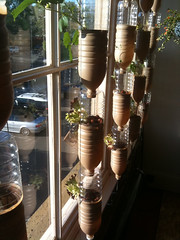
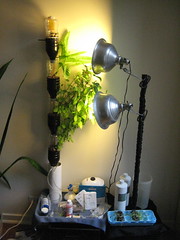
System designed by the team of  Windowfarms.org : recycled plastic bottles, rods or cables for support, silicone tubing, a few hardware parts and a small aquarium air pump. Clay pellets are used to replace the soil, water and liquid nutrient to feed your plants and you're in business.  
          
A community that has already spread throughout the world, gathered around this good idea and the dream of a healthier life on a less polluted planet.
The aim was to create a space to share their experiences with other indoor gardeners just like you and me, to ask questions or answer them, to find and share more ideas. This is a very stimulating place to go.
garden
This hydroponic system is
quite aesthetic. Another 
photo from Windowfarms.org 


On its home page, Windowfarms describes itself as a social entreprise that counts on a volunteer community of research and development (in fact, any person who is willing to experiment this type of culture, try to improve it and share his or her experience with the other members of this community).

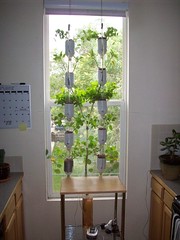
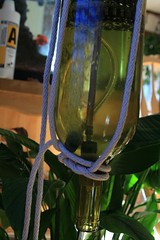
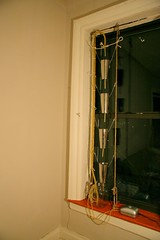
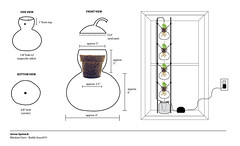
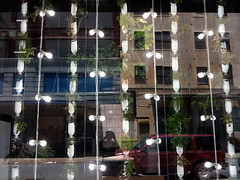
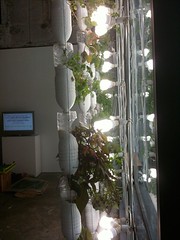
I find this communal organization ingenious, since it allows free diffusion of an unfolding expertise,  which is evident in the following photos, representing personalized versions of the original system (note on the 3rd photo below the wine bottle replacing a plastic one, the metal shakers on the 4th and the hollowed gourds on the 5th).


IMG_4141      100_2911-1     IMG_5648

      jennas2      Print

Photo by Piers Fawkes - PSFK.com      Photo by Piers Fawkes - PSFK.com


Related image
This system was comercialized in United States.
In a Windowfarm, we can grow most herbs (chives doesn't work, just like any other bulb), many greens (like lettuce or kale) or fruiting vegetables (like peppers or tomatoes).
Root vegetables (like carrots) cannot grow in such a system either. Regarding fruit crops, I harvested ground cherries and some especially talented - or lucky - windowfarmers succeeded in growing strawberries (these have the reputation of being finicky in this system). I have yet to try it. Big plants are not recommended, first because the pots are too small for their root volume, and second because the plant itself would take all the available window space.

The advantages of a Windowfarm are numerous : 
- It uses the window pane in an optimal manner;
- It allows plants to develop with a much smaller root system;
- It often gives healthier plants than it would have a normal soil-filled container;
- It is much lighter than pots full of soil;
- Since it takes advantage of the vertical space, it takes almost no horizontal space;
- Its vegetation becomes dense enough to eliminate the need for curtains;
- There's no soil to make dirty messes.

My first Windowfarm :


I named this installation "The sailboat".
It bears some modifications to the basic model,
the two most important being that there is no 
electric pump to make water circulate and I put
wooden rods horizontally  and strings to allow
plants to climb.

When I discovered the Windowfarms, I wanted to have a go right away.
In my first installation, which would have been at home in the once very popular TV series "Green Acres" (1965-71), I put 2 cherry tomatoes, 2 climbing beans (a risky business, considering the size of these giants when mature) and 2 nasturtiums. Everyone of them produced in a matter of a few months.

It takes 3 square feet of floor space for the small shelf placed right under the window sill to hold the bottom reservoir for collecting water.


So, I discovered first hand that small varieties of plants are a better choice if you don't want to have to cut them back regularly, because otherwise, the plant won't be able to develop a rootball big enough to feed all those leaves adequately.


The water tank sits over
a high shelf. A dripping
tube runs down to the
top of the highest soda
bottle. In the first
stages of construction,
a basin collected the
running water just under
the third bottle.


As a replacement for the air pump to push water up to the top of the installation, I put a tank on a high shelf. The water drips from the tank, through a tube controlled by an ajustable valve, down through the system and it ends in a reservoir hidden in a small wooden shelf under the window.

The same Windowfarm, one month later. By the end of August, vegetation covered the entirety of my window. 


One of my first beans !

A nice suspended garden :

18 pots, suspended, plus 4 simply deposited over the upper
shelf. They allow me to put 1 to 3 plants per pot in average, for 
a total of 22 to 66 plants (more if the whole installation contained 
only watercress, with six plants per pot). There are also 3 orange 
pots, full of potting soil, in which I planted garlic cloves.


After my experience with the Sailboat, I wanted to push it a little further, so I decided to use another window, this time facing South.
But since it faces the street as well, I wanted it to be beautiful. 
I also wanted to eliminate plastic for health concerns (even though I found no study proving that plastic is nocive for growing food in -  in absence of scientific data, opinions that I found were diverging).

To get to my final design, I had to think. My two main problems were that it was difficult to plug an electric pump on site and that I needed  an adequate, durable and aesthetic substitute to the soda pop bottles used in the original model. Then, I stumbled upon these non-porus glazed china pots, equipped with a draining hole in the bottom. This system cost me a lot more, but to me, it worth every penny.

I won't tell you about all my adventures with those two systems, because there has been a few. Some of them had been discouraging ones, like when a serious problem of pH imbalance killed two third of my plants and stunted the other third, stopping their growth for over a month. But on the Windowfarm website, we can read that it takes three full cycles of culture, from seed to harvest, to familiarize yourself with hydroponic culture in such a system. Therefore, I persevered and now, I congratulate myself.

On the other end, over time, I find that my own system bears irritating defects : the type of dripping valve that I have must be ajusted quite regularly, sometimes even daily, or else the water flow may be interrupted, which is very bad for the plants. They can hold on for a time, thanks to the small blocks of rock wool that I put in the pots and that act like small sponges, but right in the middle of a summer heatwave, it's another story. Therefore, I want to try another type of valve. Beside, since some members of the Windowfarm community succeeded in simplifying the electric pump system, out of lazyness and curiosity, I would like to try it on my own Windowfarm.

Here is my list of crops from Mars to the end of September 2011, out of two windows and a total of 6 square feet of floor surface required for two small shelves under each window (I use them to put a few ordinary pots, to store my material and to support the reservoirs that collect water coming from above at the end of each circulation cycle). 

Numbers :
Garlic in pots: 22 stems + 6 cloves that came out in much better shape than when I burried them.
A salad for two in april 2012 : lettuce, basil, beans,
green peas, watercress, nasturtium leaves.
In the green bowl, the only green coming from 
outside : young daylily  shoots, freshly cut by me.


And in my two Windowfarms (the Sailboat and the china pots) :
Basil : 120 leaves
Swiss Chard : 24 leaves
Nasturtiums : 57 flowers, 82 leaves
Ground cherries (Physalis) : 54 fruits
Cucumber : 1
Watercress (minimum length : 6 inches leafy stems) : 70 stems
Climbing beans : 29 pods 
Yellow bush beans : 168 pods 
Komatsuna lettuce : 94 leaves
Lettuce : 97 leaves
Mint : 40 leaves +            
Green peas : 53 pods                    
Parsley : 7 leafy stems                                
Cherry tomatoes : 32 fruits    
               
In some periods, it was enough to give us two nice salads a week. All this without any additional source of heat or artificial light.


Cherry tomato "Red Robin", a variety reputed to develop into a very small plant and for its capacity to produce fruit with less natural light (I bought the seeds from Semences Solana). In my own experience, this reputation is well earned. Appetizing, no?
February 2017 Notice : Semences Solana don't sell this variety of tomato anymore since a few years. My own old plants developped a disease which made their leaves slowly dry up and fall one by one, although the plants still gave some fruits. I discarded them and saved the seeds of a few fruits. The plants from these are also affected in the same way. I must do a second try to be sure, but I believe that this sickness is also transmitable through the seeds (from my diseased plants). If this trial ends up with the same results, I will have to find another dwarf variety as a replacement.


My Windowfarm at the end of december 2011. We can see my 
cherry-tomato (leaning on the window sill), some Komatsuna 
(a Japanese green similar to lettuce - look for the big leaves in the 
middle of the photo), and watercress (The other pots were 
temporarily empty).
This winter, I failed to start my 4th hydroponic crop, because other projects retained my full attention.
Nevertheless, let's sum up where I was in February 2012. 
I still had my "Red Robin" tomato plant and my watercress. I ripped off my Komatsuna plants, because they turned to seed after one year of loyal services (we harvest the outer leaves, the plant grows up and up, producing more leaves from its inner core).
I seeded green peas, bush beans and another nasturtium.
The number of plants that can cohabit in a single window depends mainly on the size of each plant and the surface of window they will take. For instance, two plants of lettuce won't mind sharing the same pot. Even a third one could fit in, but only two of them will get enough sun.  
On the other hand, I could put 6 cuttings of watercress and they shared the tight space without any problem. But to prevent my "Red Robin" from taking too much space, I had to cut it down and I settled to give it all the bottom part of the window. I kept the cuttings though, which was a very good deal, because on top of giving me already fifty cherry tomatoes, my older plant gave me seven new offsprings that I put in ordinary potting soil, under artificial lights. They rooted rapidly and started to produce bunches of fruit. 
My small tomato plant spread its wings ! It took root in the square pot (bottom left) and runned through the whole lenght of the window.


I seeded bush beans directly into my pots. Here we see
the first young plants, sprouting a week after the seeding.
 At some point, some pots ended up empty and I reseeded them with 16 plants of bush beans, 12 plants of green peas and 1 nasturtium. I dismantled my "Sailboat" ( my first system) during the following summer, because one day, I want to replace it with another claypot Windowfarm. The window facing South will be home for fruiting vegetables, while the one facing West will bear  leafy vegetables, since they need less sunshine.


February 2017 Update : The references given at the end of the original article are not available anymore. Therefore, I erased them. But my conclusion is still the same : 
If you decide to throw yourself in this adventure, I wish you as much fun as I've had !

mercredi 5 juin 2013

That seemingly inevitable hosta


Cet article en français.
Este artículo en Español 


Giant blue hosta invaded by peppermint. For the curious soul, there is also a black cherry tree and the plant we barely see down on the right corner is comfrey under the tree.
Hélène:
Hostas are plants that abound in the landscaping gardens in Quebec (like elsewhere, I'm sure) : So much so that I find myself very tired of looking at them. They seem to be everywhere! Even the simplest gardens tend to have at least one specimen. It is also a beginner's choice :easy to find on the market, hard to kill, minimum maintenance required, they live for many decades (60 years, apparently), their leafwork is intricate and they almost always look fine, regardless of the soil or the conditions. They tolerate a lot of shade. Furthermore, they come in an array of forms and patterns... Let's add to all this that divisions are not necessary to keep them healthy. These qualities give a lot to please the gardener, indeed. The only apparent drawback seems to be the fondness slugs and deers have for the lush foliage (especially the paler colors) and after these creatures take their fill, what's left is a sad mess.

Mouse Ear variety, a small, round-leafed
specimen that looks like the ear of a mouse.
To give a good comparison, you can spot
spearmint in-between the hosta's leaves and
on the top right corner.

But even with all those qualities, after having two gardens myself - gardens that seemed to have been created solely for hostas - they became to my eye quite unappealing, especially since I only had varieties of a dull, uniform green, plant after plant. At least, that's what I felt like until I learned to know them better.

Hostas and daylillies, 
a classic duo
Together, they surround
my peach tree.
s
Hosta Sieboldiana "Elegans"
adorned with darling flowers.


Hostas come out in mounds and, depending on the variety, some of them are just the right size to make a cute mouse house while others are big enough to suggest a dinosaur environment. At the beginning of summer, tall stalks shout out of the foliage and they hold 5 to 10 flowers. I'll be honest : I do so fancy the giant hostas with bluish complexions (like the ones on the picture at the top of this article).

 History and observations:
Did you know the hosta was at one point in history named Funkia? You can generally find this name in some work dating from the 19th century. (I have, for example, this book that refers to it as such and the name perplexed me greatly until I figured out funkia and hosta - and plantain lily - were the same. In fact, this particular book was first published in 1870). In England's Victorian Era, this plant was quite the exotic specimen. Indeed, hostas originated from Eastern Asia. About forty different species have been identified and the American Hosta Society have published a list on the internet of more than 6000 registered hybrid varieties created from those species.

Hostas can be found in so many variations, from vibrant green to deep green, golden, silver and lime tones. They can come in uniform colors or variegated (a mix of two, even three colors); there's even some that come in an orangy color at the beginning of the season ('Orange Marmalade') and others that are completely white ('White Feather'); some even have red flower stalks and rosy leaf stems ('Cherry Berry').

The flowers are trumpet shaped, blossoming on the length of a tall stalk, in white, lilac or violet shades of color. The flower has been likened to that of a lily and that's where the English second name for this plant comes from : "Plantain Lily". The flowering period can last up to 8 weeks.
Hosta "Cherry Berry", has red stalks that we unfortunately can't see on this picture. You can spot bee balm trying to make its way around in in-between the large leaves.

"Flower Power ", an enormous
perennial, comes from the crossing of
H. Nigrescens and Hosta Plantaginea.
Its flowering is especially fragrant.
 To give you an idea of the scale, the
daylily "Double Firecracker" that's on
the left can reach 60cm high (2 feets).
Hostas tend to be odorless. One variety can claim to be strongly perfumed : Hosta Plantaginea, a giant of a plant that exudes a bewitching perfume. There's also about a dozen hybrids issued from this hosta that can have a fragrant flowering. "Plantaginea Venus" even has double flowers.

Regarding its environment, one look at the large leaves can inform us on its habit. The plant is more comfortable in shade and half-shade : Indeed, the size of the leaves allow for a maximum of sun absorption. This may also be why I've seen more than one specimen unhappy when in full sun, althought some varieties are quite fine in these conditions. Green leaves can tolerate sun more than their paler cousins.

Hosta leaves make
marvelous bouquets and 
work wonderfully with
bleeding hearts, in a vase
 or in the garden regardless.


And there is more...
All of this is quite nice, but there are still more reasons to have hostas around : First, the leaves make beautiful bouquets for the house and they do last a long time! Furthermore, the tender spring shoots, before unfolding the leaves, can be blanched and eaten like asparagus... their taste being quite similar althought a tad bitter. I tested it this spring and boy, am I not disappointed!
Japanese call hostas "giboshi" and in their cuisine, "urui". They consume the shoots, the leaves and the petiole depending on the variety and the way to prepare them. The english wikipedia site mentions that the flowers are edible too! Isn't this an outstanding discovery (and considering the amount of hostas in Quebec, we could bet this may cost less than asparagus)!
I only harvested each plant once, about a third of the plant was harvested then, in order to preserve its vigour. And I can say that, two to three weeks later, my plants bore no sign of the harvest anymore. Furthermore, it doesn't look like my harvest has affected significantly the timing for its leaves to unfold.


It takes only a couple of minutes to
blanch hosta shoots.


In conclusion, after 8 years of gardening experience now, I do realize that some plants - like hostas - are just waiting to be properly introduced to me. From now on, before snobbing a plant, I will take care to learn about it : Who knows what treasures I will then uncover!


At Louise's, "Krossa Regal" hosta is an imposing specimen of 82 cm (33") high by 178 cm (70") large, the flowering is mauve and the stalks easily reach 150cm (5 foot) and more. Bigger varieties exist yet! Check this site that lists more than 80 varieties of giant hostas.
Their champion is "Gentle Giant", reaching 115 cm (46") high without even counting its flower stalks.